
Storage structure consists of registers, main memory, and magnetic disk is only one of many possible storage systems. There are also cache CD ROM, magnetic takes, and so on. Each storage system based one storing system also for holding until it is retrieved at a later time. Differences in many storage devices are based on speed, cost, size, and volatility.
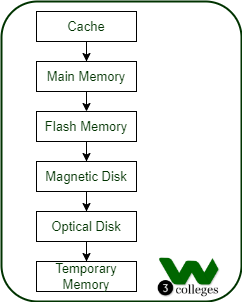
1. Main Memory
Main memory and the register built into the processor itself are the only storage that the CPU can access directly. As the operating system starts up, it divided the RAM into two broad sections. It reserves directly, a zone or partition of memory known as the system partition. The system partition always begins at the lowest addressable byte of memory(memory address O) and extends upward. The System partition contains a system leap and a set of global variables.
2. Organization of memory in the system partition
- (a) The System Heap: The main part of the device partition is a region of memory known as the system heap. For the special use of operating system. Heap is reserved and for other software components, which load into its various gadgets such as system information structure. It is also used for code as it does not belong to a specific application. All the device drivers are loaded into the system heap. Not all the
applications need to load something in heap. - (b) The System Global variable: The lowest part of the memory is active for global variable(a global variable is one which is accessed everywhere). These are used to store information about the operating system. It is also termed as low memory.
3. Organization of Memory in are Application Partition
System allocates a part of memory whenever an operating system launches an application. This will store the required code and data associated with that application. Application partition is classified into 3 types:
- (a) The application stack: The stack is a district of memory in your application partition that may grow or shrink at one finish whereas the opposite finish remains fastened. This implies that area on the stack is usually allotted and free in LIFO(last in 1st out) order.
- (b) The application heap:: An application heap is the area of memory in your application partition in which space is dynamically allocated and released on demand.
- (c) The application global variables:: The part of the memory is active for global variable(a global variable is one which is accessed everywhere). These are stored in area of memory near the top of your application partition known as application partition called as application A5 world. These are used to store information about the operating system. It is also termed as low memory.
4. Temporary Memory
Temporary memory as its name suggests refers to the memory that is volatile in nature , it is stored by the RAM i.e; Random Access Memory chip. As its name suggests the data is not stored in the memory for long. When the computer is shut down all the data will be lost. Therefore, users need to store data to permanent storage to avoid loss.