GATE CS 2024 Set 2

65 questions · Previous year paper

The GATE 2024 Computer Science and Information Technology paper, Set 2: 65 questions for 100 marks in 180 minutes, with General Aptitude (15 marks) and the technical section (85 marks). Answers follow the official final answer key; every question has a short explanation.

Take it as a timed test: ₹99

General Aptitude

Question 1

MCQ · 1 mark · −0.33

If ‘→’ denotes increasing order of intensity, then the meaning of the words

[walk → jog → sprint] is analogous to [bothered → ________ → daunted].

Which one of the given options is appropriate to fill the blank?

Options for Question 1

Explanation

Answer: (C)

Walk, jog and sprint are the same action at rising intensity. The blank therefore needs a word for being troubled that is stronger than “bothered” but milder than “daunted” (losing one’s nerve).

  • fazed means disconcerted or thrown off balance, which sits between the two.
  • phased (done in stages) only sounds like “fazed”; it says nothing about feelings.
  • phrased means put into words, and fused means joined together.

Answer: C
Question 2

MCQ · 1 mark · −0.33

Two wizards try to create a spell using all the four elements, water, air, fire, and earth. For this, they decide to mix all these elements in all possible orders. They also decide to work independently. After trying all possible combination of elements, they conclude that the spell does not work.

How many attempts does each wizard make before coming to this conclusion, independently?

Options for Question 2

Explanation

Answer: (A)

Each attempt is one order in which the four elements are mixed, with all four used every time. The number of orders of 4 different elements is

\[4! = 4 \times 3 \times 2 \times 1 = 24.\]

The wizards work independently, so each one goes through all 24 orders separately. Adding the two wizards’ attempts (48) answers a different question: the total number of attempts, not the number each wizard makes.

Answer: A

Question 3

MCQ · 1 mark · −0.33

In an engineering college of 10,000 students, 1,500 like neither their core branches nor other branches. The number of students who like their core branches is 1/4th of the number of students who like other branches. The number of students who like both their core and other branches is 500.

The number of students who like their core branches is

Options for Question 3

Explanation

Answer: (A)

Students who like at least one of the two: \(10000 - 1500 = 8500\).

Let \(c\) students like their core branches, so \(4c\) like other branches. The 500 who like both are counted in both groups, so they are subtracted once:

\[c + 4c - 500 = 8500 \implies 5c = 9000 \implies c = 1800.\]

Check: 7,200 like other branches, and \(1800 + 7200 - 500 = 8500\). Adding the 500 instead, as if those students formed a separate group, gives \(5c = 8000\), that is 1,600 (option C).

Answer: A

Question 4

MCQ · 1 mark · −0.33

For positive non-zero real variables \(x\) and \(y\), if

\[\ln\left(\frac{x + y}{2}\right) = \frac{1}{2}[\ln(x) + \ln(y)]\]

then, the value of \(\frac{x}{y} + \frac{y}{x}\) is

Options for Question 4

Explanation

Answer: (C)

The right side is a single logarithm: \(\frac{1}{2}[\ln(x) + \ln(y)] = \ln\sqrt{xy}\). Since \(\ln\) is one-to-one,

\[\frac{x + y}{2} = \sqrt{xy} \implies x - 2\sqrt{xy} + y = 0 \implies (\sqrt{x} - \sqrt{y})^{2} = 0.\]

So \(x = y\), the only case in which the arithmetic mean equals the geometric mean, and \(\frac{x}{y} + \frac{y}{x} = 1 + 1 = 2\).

Options 1 and 1/2 could never occur: for positive \(x\) and \(y\), \(\frac{x}{y} + \frac{y}{x}\) is never less than 2.

Answer: C

Question 5

MCQ · 1 mark · −0.33

In the sequence 6, 9, 14, \(x\), 30, 41, a possible value of \(x\) is

Options for Question 5

Explanation

Answer: (B)

Look at the gaps between terms: \(9 - 6 = 3\) and \(14 - 9 = 5\). They are consecutive odd numbers, so the next gaps should be 7, 9 and 11:

\[14 + 7 = 21,\quad 21 + 9 = 30,\quad 30 + 11 = 41.\]

This reproduces the given 30 and 41, so \(x = 21\). Equivalently, the terms are \(n^{2} + 5\) for \(n = 1, 2, \ldots, 6\).

The other values break the pattern: 25, 18 and 20 leave gaps of 11 and 5, 4 and 12, or 6 and 10 around \(x\).

Answer: B

Question 6

MCQ · 2 marks · −0.66

Sequence the following sentences in a coherent passage.

P: This fortuitous geological event generated a colossal amount of energy and heat that resulted in the rocks rising to an average height of 4 km across the contact zone.

Q: Thus, the geophysicists tend to think of the Himalayas as an active geological event rather than as a static geological feature.

R: The natural process of the cooling of this massive edifice absorbed large quantities of atmospheric carbon dioxide, altering the earth’s atmosphere and making it better suited for life.

S: Many millennia ago, a breakaway chunk of bedrock from the Antarctic Plate collided with the massive Eurasian Plate.

Options for Question 6

Explanation

Answer: (C)

Find the sentence that needs nothing before it, then follow the words that point back.

  • S opens: it introduces the event, a chunk of the Antarctic Plate colliding with the Eurasian Plate.
  • P follows: “This fortuitous geological event” is that collision, which pushed the rocks up.
  • R comes next: “this massive edifice” is the raised rock mass from P, now cooling.
  • Q closes: “Thus” draws the conclusion that the Himalayas are an ongoing event.

A and B begin with “Thus”, which cannot open a passage, and D places R before P, before the edifice has been formed.

Answer: C

Question 7

MCQ · 2 marks · −0.66

A person sold two different items at the same price. He made 10% profit in one item, and 10% loss in the other item. In selling these two items, the person made a total of

Options for Question 7

Explanation

Answer: (C)

Take a convenient selling price of 99 for each item.

  • 10% profit: cost price \(= \frac{99}{1.1} = 90\).
  • 10% loss: cost price \(= \frac{99}{0.9} = 110\).

The total cost is \(90 + 110 = 200\) and the total selling price is 198, so the person loses \(\frac{2}{200} \times 100 = 1\%\).

The profit and the loss do not cancel because the 10% loss is taken on the larger cost price. In general, equal selling prices with \(x\%\) profit and \(x\%\) loss always give a net loss of \(\frac{x^{2}}{100}\%\).

Answer: C

Question 8

MCQ · 2 marks · −0.66

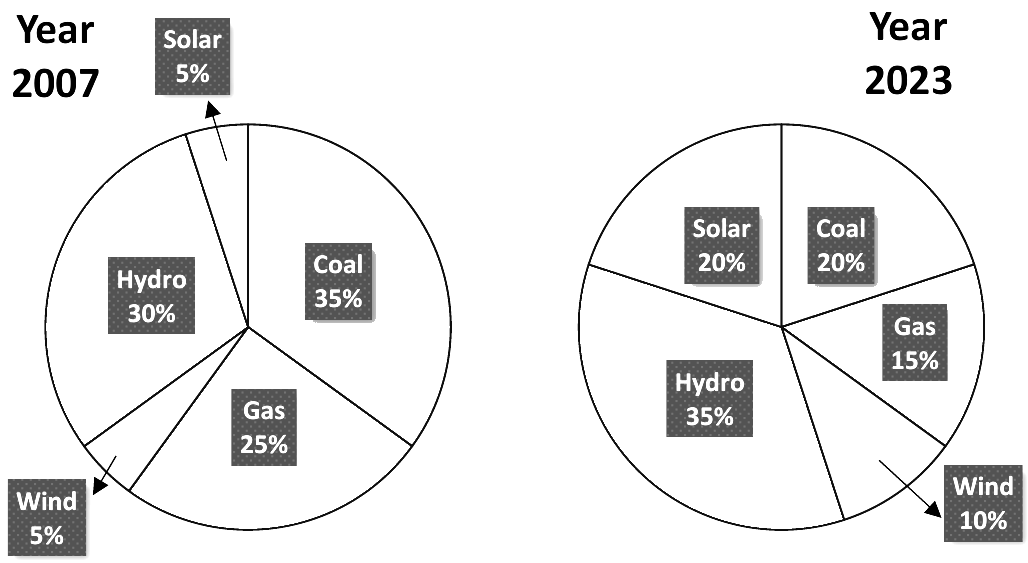
The pie charts depict the shares of various power generation technologies in the total electricity generation of a country for the years 2007 and 2023.

Two pie charts of the generation shares. In 2007: Coal 35%, Gas 25%, Hydro 30%, Wind 5% and Solar 5%; in 2023: Coal 20%, Gas 15%, Hydro 35%, Wind 10% and Solar 20%.

The renewable sources of electricity generation consist of Hydro, Solar and Wind. Assuming that the total electricity generated remains the same from 2007 to 2023, what is the percentage increase in the share of the renewable sources of electricity generation over this period?

Options for Question 8

Explanation

Answer: (D)

Add the renewable shares (Hydro, Solar and Wind) for each year:

  • 2007: \(30\% + 5\% + 5\% = 40\%\)
  • 2023: \(35\% + 20\% + 10\% = 65\%\)

The total generation is the same in both years, so the shares can be compared directly. The percentage increase is

\[\frac{65 - 40}{40} \times 100 = 62.5\%.\]

Option A (25%) is the rise in percentage points, not the increase relative to the 2007 share.

Answer: D

Question 9

MCQ · 2 marks · −0.66

A cube is to be cut into 8 pieces of equal size and shape. Here, each cut should be straight and it should not stop till it reaches the other end of the cube.

The minimum number of such cuts required is

Options for Question 9

Explanation

Answer: (A)

Three cuts are enough: cut through the centre of the cube once parallel to each pair of opposite faces. Each cut halves every piece it passes through, giving \(2 \times 2 \times 2 = 8\) identical small cubes.

Fewer cuts cannot work. A straight cut splits each existing piece into at most two, so one cut gives at most 2 pieces and two cuts at most 4. At least 3 cuts are therefore needed, and 4, 7 and 8 are all more than the minimum.

Answer: A

Question 10

MCQ · 2 marks · −0.66

In the \(4 \times 4\) array shown below, each cell of the first three rows has either a cross (X) or a number.

1X43
X554
3X6X

The number in a cell represents the count of the immediate neighboring cells (left, right, top, bottom, diagonals) NOT having a cross (X). Given that the last row has no crosses (X), the sum of the four numbers to be filled in the last row is

Options for Question 10

Explanation

Answer: (A)

The last row has no crosses, so each of its cells counts the cells beside it in row 4 plus the non-cross cells above it in row 3, which reads 3, X, 6, X.

  • Cell 1: 3 and X above, one cell beside, so 2.
  • Cell 2: 3, X and 6 above, two cells beside, so 4.
  • Cell 3: X, 6 and X above, two cells beside, so 3.
  • Cell 4: 6 and X above, one cell beside, so 2.

Sum \(= 2 + 4 + 3 + 2 = 11\). The printed numbers follow the same rule; for example, the 3 in row 3 counts the 5 diagonally above it and the two cells below it.

Answer: A

Questions 1 to 10 of 65