Discrete Mathematics

GATE CS previous year questions · 16 questions

GATE CS 2024 Set 2 | Question 15

MCQ · 1 mark · −0.33

Let \(T(n)\) be the recurrence relation defined as follows:

\(T(0) = 1\),
\(T(1) = 2\), and
\(T(n) = 5T(n - 1) - 6T(n - 2)\) for \(n \ge 2\)

Which one of the following statements is TRUE?

Options for GATE CS 2024 Set 2 | Question 15

Explanation

Answer: (A)

The characteristic equation is \(r^{2} - 5r + 6 = 0\), with roots 2 and 3, so \(T(n) = a \cdot 2^{n} + b \cdot 3^{n}\).

The initial values fix the constants: \(a + b = 1\) and \(2a + 3b = 2\), giving \(a = 1\) and \(b = 0\). Hence \(T(n) = 2^{n}\) exactly; for instance, \(T(2) = 5 \cdot 2 - 6 \cdot 1 = 4\).

These starting values make the \(3^{n}\) term vanish, so option C, which follows the larger root, is wrong here. Forms like \(n2^{n}\) and \(n3^{n}\) arise only from a repeated root.

Answer: A
GATE CS 2024 Set 2 | Question 17

MCQ · 1 mark · −0.33

Let \(A\) be the adjacency matrix of a simple undirected graph \(G\). Suppose \(A\) is its own inverse. Which one of the following statements is always TRUE?

Options for GATE CS 2024 Set 2 | Question 17

Explanation

Answer: (B)

\(A\) is its own inverse exactly when \(A^{2} = I\). The entry \((A^{2})_{ij}\) counts the walks of length 2 from vertex \(i\) to vertex \(j\).

  • The diagonal entry \((A^{2})_{ii}\) is the degree of \(i\), so \(A^{2} = I\) forces every vertex to have degree exactly 1.
  • When every degree is 1, no two vertices share a neighbour, so the off-diagonal entries are 0, as required.

So \(G\) is a set of disjoint edges, that is, a perfect matching, and every perfect matching does satisfy \(A^{2} = I\). A cycle fails because its vertices have degree 2. A complete graph works only as \(K_{2}\), a single edge, so two disjoint edges already show that C is not always true. A single edge also rules out D.

Answer: B

GATE CS 2024 Set 2 | Question 34

NAT · 1 mark

Let \(P\) be the partial order defined on the set \(\{1,2,3,4\}\) as follows

\[P = \{(x, x) \mid x \in \{1,2,3,4\}\} \cup \{(1,2), (3,2), (3,4)\}\]

The number of total orders on \(\{1,2,3,4\}\) that contain \(P\) is __________

Explanation

Answer: 5

A total order that contains \(P\) is a linear extension of \(P\): an arrangement of 1, 2, 3, 4 in which 1 comes before 2, 3 comes before 2, and 3 comes before 4. Only the minimal elements 1 and 3 can come first.

  • First 1: among 2, 3, 4 the element 3 must lead, and 2 and 4 follow in either order: 1, 3, 2, 4 and 1, 3, 4, 2.
  • First 3: the remaining 1, 2, 4 only need 1 before 2, which half of their \(3! = 6\) orders satisfy: 3, 1, 2, 4; 3, 1, 4, 2; 3, 4, 1, 2.

So \(2 + 3 = 5\) total orders contain \(P\).

Answer: 5

GATE CS 2024 Set 2 | Question 51

MSQ · 2 marks

Let \(G\) be an undirected connected graph in which every edge has a positive integer weight. Suppose that every spanning tree in \(G\) has even weight. Which of the following statements is/are TRUE for every such graph \(G\) ?

Options for GATE CS 2024 Set 2 | Question 51

Explanation

Answer: (D)

(D) holds. Suppose a cycle \(C\) has an even edge \(e\) and an odd edge \(f\). Extend the path \(C - f\) to a spanning tree \(T\); it contains \(e\) but not \(f\). Removing \(e\) splits \(T\) into two parts, and \(f\) must join them, because the rest of the cycle links the ends of \(e\). So \(T - e + f\) is another spanning tree whose weight differs from that of \(T\) by an odd amount, and both cannot be even.

The others fail. A triangle with weights 1, 1, 1 has every spanning tree of weight 2, yet its edges are odd, which rules out (A) and (C). A path with weights 1, 1, 2 is its own only spanning tree (weight 4) and mixes parities, which rules out (B).

Answer: D

GATE CS 2024 Set 2 | Question 60

NAT · 2 marks

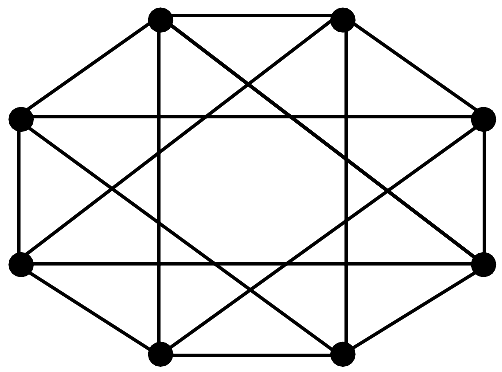
The chromatic number of a graph is the minimum number of colours used in a proper colouring of the graph. The chromatic number of the following graph is _________

Eight dots at the corners of an octagon (two along the top, two on the left side, two on the right side and two along the bottom), joined by the octagon’s eight sides. Eight more edges join each top dot to the bottom dot directly below it, each left-side dot to the right-side dot level with it, the top-left dot to the lower right-side dot, the top-right dot to the lower left-side dot, the upper left-side dot to the bottom-right dot, and the upper right-side dot to the bottom-left dot.

Explanation

Answer: 2

Any graph with an edge needs at least 2 colours, and exactly 2 suffice when the graph is bipartite. Go round the octagon and colour the corners alternately red and blue; the eight sides are properly coloured because 8 is even.

Every other edge (the two verticals, the two horizontals and the four long diagonals) joins two corners that are three steps apart around the octagon. Three is odd, so each of them joins a red corner to a blue corner.

No edge joins two corners of the same colour, so the graph is bipartite (it is in fact \(K_{4,4}\)) and its chromatic number is 2.

Answer: 2

GATE CS 2024 Set 2 | Question 63

NAT · 2 marks

Let \(Z_n\) be the group of integers \(\{0, 1, 2, \ldots, n - 1\}\) with addition modulo \(n\) as the group operation. The number of elements in the group \(Z_2 \times Z_3 \times Z_4\) that are their own inverses is ________

Explanation

Answer: 4

The product group works coordinate by coordinate, so \((x, y, z)\) is its own inverse exactly when \(2x \equiv 0 \pmod 2\), \(2y \equiv 0 \pmod 3\) and \(2z \equiv 0 \pmod 4\).

  • In \(Z_2\): both 0 and 1 work (2 choices).
  • In \(Z_3\): only 0 works, since \(2 \cdot 1 = 2\) and \(2 \cdot 2 = 4 \equiv 1\) (1 choice).
  • In \(Z_4\): 0 and 2 work (2 choices).

So there are \(2 \times 1 \times 2 = 4\) such elements: \((0,0,0), (0,0,2), (1,0,0), (1,0,2)\). The identity \((0,0,0)\) counts, since it is its own inverse.

Answer: 4