Analytical Aptitude

GATE CS previous year questions · 4 questions

GATE CS 2025 Set 2 | Question 7

MCQ · 2 marks · −0.66

If IMAGE and FIELD are coded as FHBNJ and EMFJG respectively then, which one among the given options is the most appropriate code for BEACH ?

Options for GATE CS 2025 Set 2 | Question 7

Explanation

Answer: (B)

Compare IMAGE with FHBNJ. Moving each letter of IMAGE one step forward in the alphabet gives J N B H F, and writing that in reverse order gives FHBNJ. FIELD follows the same rule: one step forward gives G J F M E, which reversed is EMFJG.

For BEACH, one step forward gives C F B D I, and reversing it gives IDBFC. None of the other options fits this rule.

Answer: B
GATE CS 2025 Set 2 | Question 8

MCQ · 2 marks · −0.66

Which one of the following options is correct for the given data in the table?

Iteration (\(i\))0123
Input (\(I\))20−41015
Output (\(X\))20162641
Output (\(Y\))20−80−800−12000
Options for GATE CS 2025 Set 2 | Question 8

Explanation

Answer: (A)

Test the first step, \(i = 1\), where \(I(1) = -4\):

  • \(X\): \(20 + (-4) = 16\) matches, while \(20 \times (-4) = -80\) does not, so \(X\) is a running sum. This rules out B and C.
  • \(Y\): \(20 \times (-4) = -80\) matches, so \(Y\) is multiplied by the current input. D would give \(20 \times 20 = 400\) instead.

The rule in A also fits the later columns: \(16 + 10 = 26\), \(26 + 15 = 41\), \(-80 \times 10 = -800\) and \(-800 \times 15 = -12000\).

Answer: A

GATE CS 2025 Set 2 | Question 10

MCQ · 2 marks · −0.66

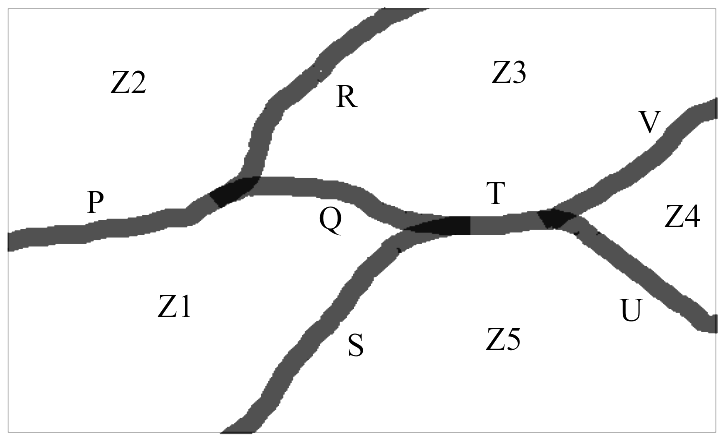
The diagram below shows a river system consisting of 7 segments, marked P, Q, R, S, T, U, and V. It splits the land into 5 zones, marked Z1, Z2, Z3, Z4, and Z5. We need to connect these zones using the least number of bridges. Out of the following options, which one is correct?

Note: The figure shown is representative.

A river map: segment P runs in from the left edge between Z2 (above) and Z1 (below) to a junction, where R rises to the top edge between Z2 and Z3 and Q continues right between Z3 and Z1. Q ends where S runs down to the bottom edge between Z1 and Z5 and T continues right between Z3 and Z5, and T then splits into V (between Z3 and Z4) and U (between Z4 and Z5).
Options for GATE CS 2025 Set 2 | Question 10

Explanation

Answer: (C)

Treat each zone as a point and each river segment as a possible bridge between the two zones on its banks: P (Z1–Z2), R (Z2–Z3), Q (Z1–Z3), S (Z1–Z5), T (Z3–Z5), V (Z3–Z4) and U (Z4–Z5).

Joining 5 zones needs at least 4 bridges, and 4 are enough only if they reach every zone without forming a loop.

  • A has only 3 bridges and leaves Z4 cut off.
  • B also leaves Z4 cut off, and its bridges on Q, S and T join Z1, Z3 and Z5 in a loop.
  • C joins Z1, Z2, Z4 and Z5 each to Z3, so all zones are connected with 4 bridges.
  • D connects every zone but uses 5 bridges.

Answer: C

GATE CS 2024 Set 2 | Question 10

MCQ · 2 marks · −0.66

In the \(4 \times 4\) array shown below, each cell of the first three rows has either a cross (X) or a number.

1X43
X554
3X6X

The number in a cell represents the count of the immediate neighboring cells (left, right, top, bottom, diagonals) NOT having a cross (X). Given that the last row has no crosses (X), the sum of the four numbers to be filled in the last row is

Options for GATE CS 2024 Set 2 | Question 10

Explanation

Answer: (A)

The last row has no crosses, so each of its cells counts the cells beside it in row 4 plus the non-cross cells above it in row 3, which reads 3, X, 6, X.

  • Cell 1: 3 and X above, one cell beside, so 2.
  • Cell 2: 3, X and 6 above, two cells beside, so 4.
  • Cell 3: X, 6 and X above, two cells beside, so 3.
  • Cell 4: 6 and X above, one cell beside, so 2.

Sum \(= 2 + 4 + 3 + 2 = 11\). The printed numbers follow the same rule; for example, the 3 in row 3 counts the 5 diagonally above it and the two cells below it.

Answer: A