General Aptitude

GATE CS previous year questions · 40 questions

GATE CS 2025 Set 2 | Question 1

MCQ · 1 mark · −0.33

Despite his initial hesitation, Rehman’s _________ to contribute to the success of the project never wavered.

Select the most appropriate option to complete the above sentence.

Options for GATE CS 2025 Set 2 | Question 1

Explanation

Answer: (C)

The sentence contrasts Rehman’s early hesitation with something that “never wavered”. The blank therefore needs a noun meaning firm determination, one that can be followed by “to contribute”.

  • resolve (as a noun) means exactly that: his resolve to contribute never wavered.
  • ambivalence means mixed feelings, the opposite of something unwavering.
  • satisfaction is contentment, not a commitment, and does not take “to contribute”.
  • revolve is a verb meaning to turn around, so it cannot follow “Rehman’s”.

Answer: C
GATE CS 2025 Set 2 | Question 2

MCQ · 1 mark · −0.33

Bird : Nest :: Bee : _______

Select the correct option to complete the analogy.

Options for GATE CS 2025 Set 2 | Question 2

Explanation

Answer: (C)

A bird builds a nest and lives in it. The structure that bees build and live in is a hive, so Bee : Hive keeps the same relation.

The other words do not fit: a kennel is a shelter for a dog, a lair is the den of a wild animal such as a fox or a lion, and a hammock is a hanging bed for people.

Answer: C

GATE CS 2025 Set 2 | Question 3

MCQ · 1 mark · −0.33

If \(Pe^{x} = Qe^{-x}\) for all real values of \(x\), which one of the following statements is true?

Options for GATE CS 2025 Set 2 | Question 3

Explanation

Answer: (A)

Multiply both sides by \(e^{x}\) to get \(Pe^{2x} = Q\), which must hold for every real \(x\).

At \(x = 0\) this gives \(P = Q\), and at \(x = \frac{1}{2}\ln 2\) it gives \(2P = Q\). Together these force \(P = 0\), and then \(Q = 0\). In short, \(e^{2x}\) keeps changing, so \(Pe^{2x}\) can stay equal to the constant \(Q\) only when \(P = 0\).

  • B holds only at \(x = 0\).
  • C would make the positive number \(e^{x}\) equal the negative number \(-e^{-x}\).
  • D needs \(P = 0\) with \(Q \neq 0\), but \(P = 0\) forces \(Q = 0\) as well.

Answer: A

GATE CS 2025 Set 2 | Question 4

MCQ · 1 mark · −0.33

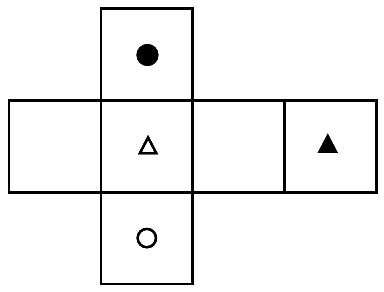
The paper as shown in the figure is folded to make a cube where each square corresponds to a particular face of the cube. Which one of the following options correctly represents the cube?

Note: The figures shown are representative.

A cross-shaped net of six squares: a middle row of four squares that are, from left to right, blank, an open triangle, blank and a filled triangle, with a filled circle in the square above the open triangle and an open circle in the square below it.
Options for GATE CS 2025 Set 2 | Question 4

Explanation

Answer: (A)

Fold the net with the open triangle at the front. The filled circle above it becomes the top, the open circle below it the bottom, and the blank squares on either side the left and right faces. The filled triangle, two squares to the right, lands at the back.

So the opposite pairs are: open triangle and filled triangle, filled circle and open circle, and the two blank faces.

  • B and D show the filled triangle next to the open triangle, but those faces are opposite.
  • C shows two blank faces sharing an edge, but the blank faces are opposite.
  • A shows the open triangle with the filled circle above it and a blank face beside it, exactly as folded.

Answer: A

GATE CS 2025 Set 2 | Question 5

MCQ · 1 mark · −0.33

Let \(p_{1}\) and \(p_{2}\) denote two arbitrary prime numbers. Which one of the following statements is correct for all values of \(p_{1}\) and \(p_{2}\)?

Options for GATE CS 2025 Set 2 | Question 5

Explanation

Answer: (B)

The product \(p_{1}p_{2}\) is divisible by \(p_{1}\), which is neither 1 nor the product itself (because \(p_{2} \ge 2\)). So \(p_{1}p_{2}\) always has a third divisor and is never prime, even when \(p_{1} = p_{2}\). Statement B holds for all primes.

One counterexample rules out each other option:

  • A: \(2 + 3 = 5\) is prime.
  • C: \(3 + 5 + 1 = 9\) is not prime.
  • D: \(3 \times 5 + 1 = 16\) is not prime.

Answer: B

GATE CS 2025 Set 2 | Question 6

MCQ · 2 marks · −0.66

Based only on the conversation below, identify the logically correct inference:

“Even if I had known that you were in the hospital, I would not have gone there to see you”, Ramya told Josephine.

Options for GATE CS 2025 Set 2 | Question 6

Explanation

Answer: (B)

Ramya’s sentence is a counterfactual: “if I had known …, I would not have …”. This form describes a situation that did not happen, so it tells us that Ramya did not, in fact, know that Josephine was in the hospital. Her point is that knowing would not have changed anything.

  • A contradicts that meaning.
  • C and D may or may not be true, but nothing in the sentence mentions a past friendship or the cause of the hospital stay.

Answer: B

GATE CS 2025 Set 2 | Question 7

MCQ · 2 marks · −0.66

If IMAGE and FIELD are coded as FHBNJ and EMFJG respectively then, which one among the given options is the most appropriate code for BEACH ?

Options for GATE CS 2025 Set 2 | Question 7

Explanation

Answer: (B)

Compare IMAGE with FHBNJ. Moving each letter of IMAGE one step forward in the alphabet gives J N B H F, and writing that in reverse order gives FHBNJ. FIELD follows the same rule: one step forward gives G J F M E, which reversed is EMFJG.

For BEACH, one step forward gives C F B D I, and reversing it gives IDBFC. None of the other options fits this rule.

Answer: B

GATE CS 2025 Set 2 | Question 8

MCQ · 2 marks · −0.66

Which one of the following options is correct for the given data in the table?

Iteration (\(i\))0123
Input (\(I\))20−41015
Output (\(X\))20162641
Output (\(Y\))20−80−800−12000
Options for GATE CS 2025 Set 2 | Question 8

Explanation

Answer: (A)

Test the first step, \(i = 1\), where \(I(1) = -4\):

  • \(X\): \(20 + (-4) = 16\) matches, while \(20 \times (-4) = -80\) does not, so \(X\) is a running sum. This rules out B and C.
  • \(Y\): \(20 \times (-4) = -80\) matches, so \(Y\) is multiplied by the current input. D would give \(20 \times 20 = 400\) instead.

The rule in A also fits the later columns: \(16 + 10 = 26\), \(26 + 15 = 41\), \(-80 \times 10 = -800\) and \(-800 \times 15 = -12000\).

Answer: A

GATE CS 2025 Set 2 | Question 9

MCQ · 2 marks · −0.66

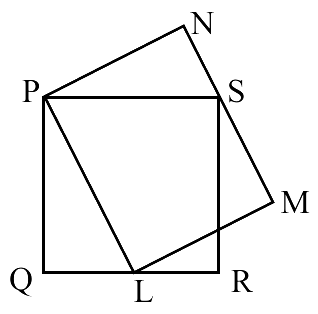
In the given figure, PQRS is a square of side 2 cm and PLMN is a rectangle. The corner L of the rectangle is on the side QR. Side MN of the rectangle passes through the corner S of the square.

What is the area (in cm2) of the rectangle PLMN?

Note: The figure shown is representative.

Square PQRS with P at the top left, S at the top right, R at the bottom right and Q at the bottom left. A tilted rectangle PLMN shares corner P with the square, has corner L on side QR, and its side MN passes through S, with N above the square and M to its right.
Options for GATE CS 2025 Set 2 | Question 9

Explanation

Answer: (D)

Find the area of triangle PLS in two ways.

  • With base PS: PS = 2 cm, and L lies on QR, which is 2 cm from PS. So the area is \(\frac{1}{2} \times 2 \times 2 = 2\) cm2.
  • With base PL: S lies on MN, which is parallel to PL at a distance LM. So the area is \(\frac{1}{2} \times PL \times LM\), half the rectangle.

Hence the rectangle’s area is \(2 \times 2 = 4\) cm2, wherever L sits on QR.

Answer: D

GATE CS 2025 Set 2 | Question 10

MCQ · 2 marks · −0.66

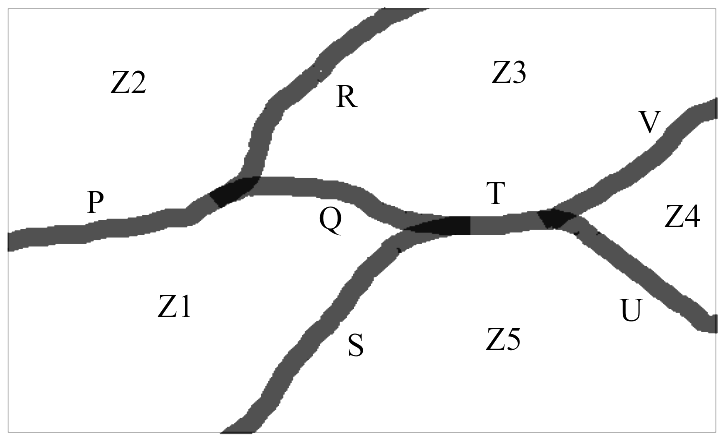
The diagram below shows a river system consisting of 7 segments, marked P, Q, R, S, T, U, and V. It splits the land into 5 zones, marked Z1, Z2, Z3, Z4, and Z5. We need to connect these zones using the least number of bridges. Out of the following options, which one is correct?

Note: The figure shown is representative.

A river map: segment P runs in from the left edge between Z2 (above) and Z1 (below) to a junction, where R rises to the top edge between Z2 and Z3 and Q continues right between Z3 and Z1. Q ends where S runs down to the bottom edge between Z1 and Z5 and T continues right between Z3 and Z5, and T then splits into V (between Z3 and Z4) and U (between Z4 and Z5).
Options for GATE CS 2025 Set 2 | Question 10

Explanation

Answer: (C)

Treat each zone as a point and each river segment as a possible bridge between the two zones on its banks: P (Z1–Z2), R (Z2–Z3), Q (Z1–Z3), S (Z1–Z5), T (Z3–Z5), V (Z3–Z4) and U (Z4–Z5).

Joining 5 zones needs at least 4 bridges, and 4 are enough only if they reach every zone without forming a loop.

  • A has only 3 bridges and leaves Z4 cut off.
  • B also leaves Z4 cut off, and its bridges on Q, S and T join Z1, Z3 and Z5 in a loop.
  • C joins Z1, Z2, Z4 and Z5 each to Z3, so all zones are connected with 4 bridges.
  • D connects every zone but uses 5 bridges.

Answer: C