GATE DA 2024

65 questions · Previous year paper

The GATE 2024 Data Science and Artificial Intelligence paper: 65 questions for 100 marks in 180 minutes, with General Aptitude (15 marks) and the technical section (85 marks). Answers follow the official final answer key; every question has a short explanation.

Take it as a timed test: ₹49

Data Science and Artificial Intelligence

Question 51

MSQ · 2 marks

Consider the directed acyclic graph (DAG) below:
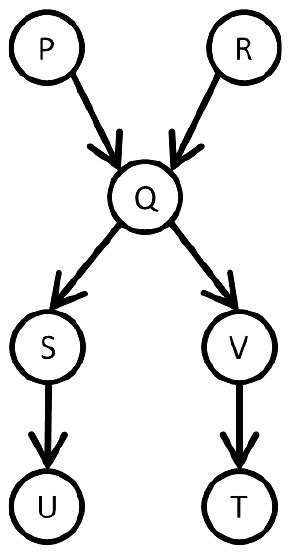
Directed graph with seven vertices: P and R each have an edge into Q, Q has edges to S and V, S has an edge to U, and V has an edge to T.

Which of the following is/are valid vertex orderings that can be obtained from a topological sort of the DAG?

Options for Question 51

Explanation

Answer: (B), (D)

In a topological order every edge points forward, so each vertex comes after all of its predecessors. The edges are \(P \to Q\), \(R \to Q\), \(Q \to S\), \(Q \to V\), \(S \to U\) and \(V \to T\): P and R must precede Q, Q must precede S and V, S must precede U, and V must precede T.

  • A and C fail: both place Q before R, which breaks the edge \(R \to Q\).
  • B holds: after P, R, Q come V, S, U, T, so U follows S and T follows V.
  • D holds: P, R, Q, S, V, T, U also respects every edge.

More than one order is valid because the chains \(S \to U\) and \(V \to T\) do not depend on each other.

Answer: B, D
Question 52

MSQ · 2 marks

Let \(H, I, L\), and \(N\) represent height, number of internal nodes, number of leaf nodes, and the total number of nodes respectively in a rooted binary tree.

Which of the following statements is/are always TRUE?

Options for Question 52

Explanation

Answer: (A), (B), (C)

Height here is the number of edges on the longest root-to-leaf path, so a single node has height 0; the bounds in the options use this convention.

  • A holds: if \(n_{2}\) nodes have two children, the tree has exactly \(L = n_{2} + 1\) leaves, and those \(n_{2}\) nodes are internal, so \(L \le I + 1\).
  • B holds: the longest path alone has \(H + 1\) nodes, and levels 0 to \(H\) hold at most \(1 + 2 + \dots + 2^{H} = 2^{H+1} - 1\) nodes.
  • C holds: the first \(H\) nodes on the longest path are internal, and internal nodes can sit only on levels 0 to \(H - 1\), which hold at most \(2^{H} - 1\) nodes.
  • D fails: a path of height 2 has a single leaf, so \(H \le L\) breaks, and a perfect tree has \(2^{H}\) leaves, more than \(2^{H-1}\).

Answer: A, B, C

Question 53

MSQ · 2 marks

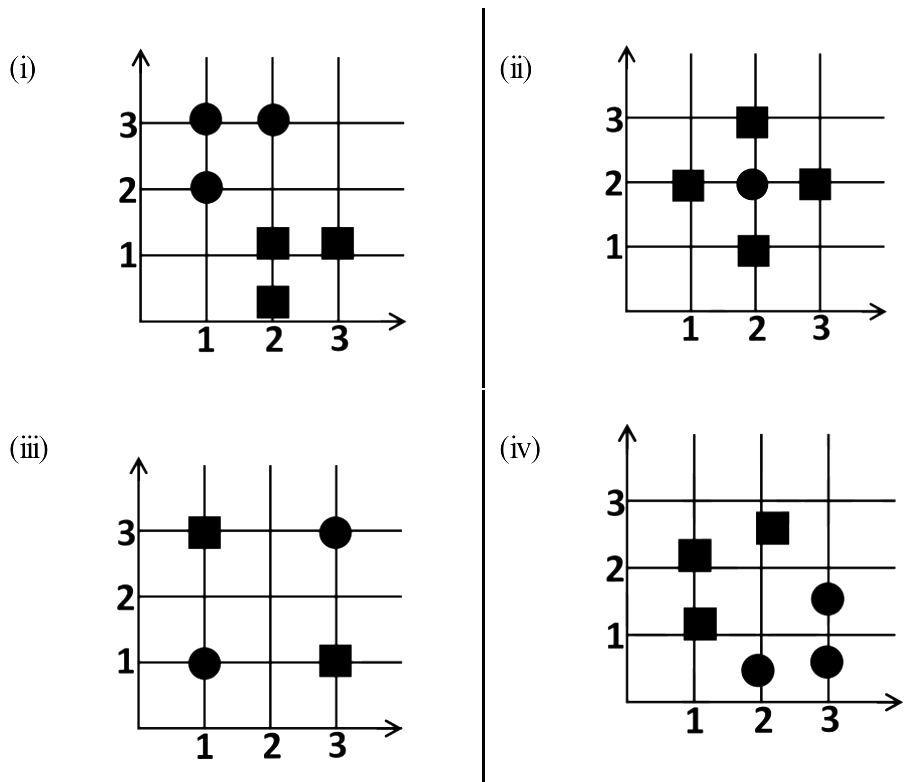
Consider the following figures representing datasets consisting of two-dimensional features with two classes denoted by circles and squares.

Four scatter plots labelled (i) to (iv), each with filled circles and filled squares on axes marked 1 to 3. In (i) circles are at (1, 3), (2, 3) and (1, 2) and squares at about (2, 1), (3, 1) and (2, 0.3); in (ii) a circle is at (2, 2) and squares at (1, 2), (3, 2), (2, 3) and (2, 1); in (iii) squares are at (1, 3) and (3, 1) and circles at (1, 1) and (3, 3); in (iv) squares are at about (1, 2.2), (1, 1.2) and (2, 2.6) and circles at about (2, 0.5), (3, 1.5) and (3, 0.6).

Which of the following is/are TRUE?

Options for Question 53

Explanation

Answer: (A), (D)

A dataset is linearly separable when a single straight line puts every circle on one side and every square on the other.

  • A holds: in (i) the circles have \(y \ge 2\) and the squares lie around \(y = 1\) or lower, so the line \(y = 1.6\) splits them.
  • B fails: in (ii) the circle at (2, 2) is the midpoint of the squares at (1, 2) and (3, 2). A half-plane holding both squares also holds their midpoint, so the circle cannot be cut off.
  • C fails: (iii) is the XOR pattern. The circles (1, 1), (3, 3) and the squares (1, 3), (3, 1) have the same midpoint (2, 2), which would have to lie on both sides.
  • D holds: in (iv) the squares sit to the upper left and the circles to the lower right, so a slanted line such as \(y = x - 0.3\) works.

Answer: A, D

Question 54

MSQ · 2 marks

Let game(ball, rugby) be true if the ball is used in rugby and false otherwise.

Let shape(ball, round) be true if the ball is round and false otherwise.

Consider the following logical sentences:

s1: \(\forall \textit{ball}\ \neg\, \textit{game(ball, rugby)} \Longrightarrow \textit{shape(ball, round)}\)

s2: \(\forall \textit{ball}\ \neg\, \textit{shape(ball, round)} \Longrightarrow \textit{game(ball, rugby)}\)

s3: \(\forall \textit{ball}\ \textit{game(ball, rugby)} \Longrightarrow \neg\, \textit{shape(ball, round)}\)

s4: \(\forall \textit{ball}\ \textit{shape(ball, round)} \Longrightarrow \neg\, \textit{game(ball, rugby)}\)

Which of the following choices is/are logical representations of the assertion,
“All balls are round except balls used in rugby”?

Options for Question 54

Explanation

Answer: (A), (C)

The assertion says two things about every ball: a ball not used in rugby is round, and a ball used in rugby is not round.

  • s1 states the first part, and s2 is its contrapositive (a ball that is not round is used in rugby), so s1 and s2 say the same thing.
  • s3 states the second part, and s4 is its contrapositive, so s3 and s4 say the same thing.

A correct representation needs one sentence from each pair, so \(s1 \wedge s3\) (A) and \(s2 \wedge s3\) (C) both work. Option B repeats the first part and would still allow a round rugby ball; option D repeats the second part and would allow a non-rugby ball that is not round.

Answer: A, C

Question 55

MSQ · 2 marks

An OTT company is maintaining a large disk-based relational database of different movies with the following schema:

Movie(ID, CustomerRating)
Genre(ID, Name)
Movie_Genre(MovieID, GenreID)

Consider the following SQL query on the relation database above:

SELECT *
FROM Movie, Genre, Movie_Genre
WHERE
     Movie.CustomerRating > 3.4 AND
     Genre.Name = "Comedy" AND
     Movie_Genre.MovieID = Movie.ID AND
     Movie_Genre.GenreID = Genre.ID;

This SQL query can be sped up using which of the following indexing options?

Options for Question 55

Explanation

Answer: (A), (B)

The query has one range condition, Movie.CustomerRating > 3.4, and only equality conditions otherwise: Genre.Name = "Comedy" and the two join conditions on the IDs.

  • A B+ tree keeps its keys in sorted order, so it serves range searches as well as equality lookups.
  • A hash index places keys by their hash values, so it can only find exact matches; it cannot list all ratings above 3.4.

A (B+ trees everywhere) and B (a hash index only on the equality attribute Genre.Name, B+ trees elsewhere) give every condition an index it can use. C and D put a hash index on CustomerRating, which cannot help the range condition, so the selection on Movie would still need a full scan.

Answer: A, B

Question 56

NAT · 2 marks

Let \(X\) be a random variable uniformly distributed in the interval [1, 3] and \(Y\) be a random variable uniformly distributed in the interval [2, 4]. If \(X\) and \(Y\) are independent of each other, the probability \(P(X \ge Y)\) is ______ (rounded off to three decimal places).

Explanation

Answer: 0.13

By independence, \((X, Y)\) is uniform on the rectangle \([1, 3] \times [2, 4]\), whose area is 4, so a probability is the favourable area divided by 4.

Since \(Y\) is never below 2, \(X \ge Y\) can only happen when \(X \ge 2\). The favourable region is the triangle \(2 \le Y \le X \le 3\), with both legs of length 1:

\[ \text{area} = \int_{2}^{3} (x - 2)\,dx = \frac{1}{2}, \qquad P(X \ge Y) = \frac{1/2}{4} = \frac{1}{8} = 0.125 \]

Answer: 0.125

Question 57

NAT · 2 marks

Let \(X\) be a random variable exponentially distributed with parameter \(\lambda > 0\). The probability density function of \(X\) is given by:

\[ f_{X}(x) = \begin{cases} \lambda e^{-\lambda x}, & x \ge 0 \\ 0, & \textit{otherwise} \end{cases} \]

If \(5E(X) = Var(X)\), where \(E(X)\) and \(Var(X)\) indicate the expectation and variance of \(X\), respectively, the value of \(\lambda\) is ______ (rounded off to one decimal place).

Explanation

Answer: 0.2

For an exponential random variable with rate \(\lambda\):

\[ E(X) = \int_{0}^{\infty} x\lambda e^{-\lambda x}\,dx = \frac{1}{\lambda}, \qquad Var(X) = E(X^{2}) - E(X)^{2} = \frac{2}{\lambda^{2}} - \frac{1}{\lambda^{2}} = \frac{1}{\lambda^{2}} \]

The condition \(5E(X) = Var(X)\) becomes \(\frac{5}{\lambda} = \frac{1}{\lambda^{2}}\). Multiplying by \(\lambda^{2}\), which is allowed because \(\lambda > 0\), gives \(5\lambda = 1\), so \(\lambda = 0.2\).

Taking the mean as \(\lambda\) instead of \(1/\lambda\) is the usual slip; it would give \(\lambda = 5\).

Answer: 0.2

Question 58

NAT · 2 marks

Consider two events \(T\) and \(S\). Let \(\overline{T}\) denote the complement of the event \(T\). The probability associated with different events are given as follows:

\[ P(\overline{T}) = 0.6, \qquad P(S|T) = 0.3, \qquad P(S|\overline{T}) = 0.6 \]

Then, \(P(T|S)\) is ______ (rounded off to two decimal places).

Explanation

Answer: 0.25

First, \(P(T) = 1 - P(\overline{T}) = 0.4\). By the law of total probability,

\[ P(S) = P(S|T)P(T) + P(S|\overline{T})P(\overline{T}) = 0.3 \times 0.4 + 0.6 \times 0.6 = 0.12 + 0.36 = 0.48 \]

Bayes' theorem then reverses the conditioning:

\[ P(T|S) = \frac{P(S|T)P(T)}{P(S)} = \frac{0.12}{0.48} = 0.25 \]

Note that \(P(T|S) = 0.25\) differs from the given \(P(S|T) = 0.3\); confusing the two is the common trap.

Answer: 0.25

Question 59

NAT · 2 marks

Consider a joint probability density function of two random variables \(X\) and \(Y\)

\[ f_{X,Y}(x, y) = \begin{cases} 2xy, & 0 < x < 2, \quad 0 < y < x \\ 0, & \text{otherwise} \end{cases} \]

Then, \(E[Y|X = 1.5]\) is ______.

Explanation

Answer: 1 (marks to all)

The marks went to all because the printed function is not a valid density: over its region it integrates to \(\int_{0}^{2}\int_{0}^{x} 2xy\,dy\,dx = \int_{0}^{2} x^{3}\,dx = 4\), not 1.

The conditional expectation can still be found as printed, because a constant factor cancels in a conditional density. For a fixed \(x\),

\[ f_{Y|X}(y|x) = \frac{2xy}{\int_{0}^{x} 2xy\,dy} = \frac{2xy}{x^{3}} = \frac{2y}{x^{2}}, \quad 0 < y < x \]

\[ E[Y|X = x] = \int_{0}^{x} y \cdot \frac{2y}{x^{2}}\,dy = \frac{2x}{3}, \qquad E[Y|X = 1.5] = \frac{2 \times 1.5}{3} = 1 \]

Answer: 1

Question 60

NAT · 2 marks

Evaluate the following limit:

\[ \lim_{x \to 0} \frac{\ln((x^{2}+1)\cos x)}{x^{2}} = \]

______.

Explanation

Answer: 0.5

The logarithm of a product splits into a sum:

\[ \frac{\ln((x^{2}+1)\cos x)}{x^{2}} = \frac{\ln(1 + x^{2})}{x^{2}} + \frac{\ln(\cos x)}{x^{2}} \]

  • Since \(\ln(1 + t) \approx t\) for small \(t\), the first term tends to 1.
  • Since \(\cos x \approx 1 - \frac{x^{2}}{2}\), we get \(\ln(\cos x) \approx -\frac{x^{2}}{2}\), so the second term tends to \(-\frac{1}{2}\).

The limit is \(1 - \frac{1}{2} = 0.5\). L'Hôpital's rule agrees: differentiating the top and the bottom gives \(\frac{2x/(1 + x^{2}) - \tan x}{2x}\), which also tends to \(1 - \frac{1}{2}\).

Answer: 0.5

Questions 51 to 60 of 65