Consider the table below, where the \((i, j)^{th}\) element of the table is the distance between points \(x_{i}\) and \(x_{j}\). Single linkage clustering is performed on data points, \(x_{1}, x_{2}, x_{3}, x_{4}, x_{5}\).
| \(x_{1}\) | \(x_{2}\) | \(x_{3}\) | \(x_{4}\) | \(x_{5}\) | |
|---|---|---|---|---|---|
| \(x_{1}\) | 0 | 1 | 4 | 3 | 6 |
| \(x_{2}\) | 1 | 0 | 3 | 5 | 3 |
| \(x_{3}\) | 4 | 3 | 0 | 2 | 5 |
| \(x_{4}\) | 3 | 5 | 2 | 0 | 1 |
| \(x_{5}\) | 6 | 3 | 5 | 1 | 0 |
Which ONE of the following is the correct representation of the clusters produced?
-
Option A:
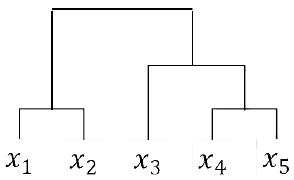 (correct)
-
Option B:
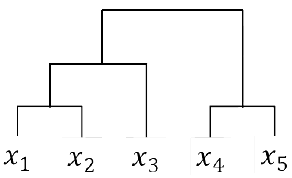
-
Option C:
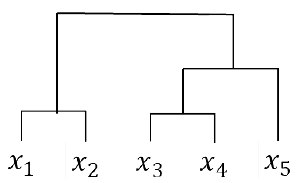
-
Option D:
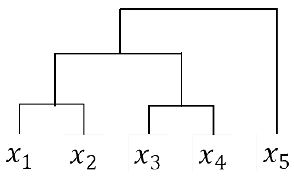
Answer
(A)
Explanation
Single linkage repeatedly merges the two clusters whose closest members are nearest to each other.
- Distance 1: \(x_{1}\) joins \(x_{2}\), and \(x_{4}\) joins \(x_{5}\).
- Distance 2: \(x_{3}\) joins \(\{x_{4}, x_{5}\}\) through \(d(x_{3}, x_{4}) = 2\); the pair \(\{x_{1}, x_{2}\}\) is at least 3 from every other point.
- Distance 3: \(\{x_{1}, x_{2}\}\) joins \(\{x_{3}, x_{4}, x_{5}\}\), for example through \(d(x_{1}, x_{4}) = 3\).
Dendrogram A shows exactly this. B attaches \(x_{3}\) to \(\{x_{1}, x_{2}\}\), where its nearest link is 3, not 2. C and D pair \(x_{3}\) with \(x_{4}\) first, although \(d(x_{4}, x_{5}) = 1\) is smaller than \(d(x_{3}, x_{4}) = 2\).
Answer: A