GATE DA 2025

65 questions · Previous year paper

The GATE 2025 Data Science and Artificial Intelligence paper: 65 questions for 100 marks in 180 minutes, with General Aptitude (15 marks) and the technical section (85 marks). Answers follow the official final answer key; every question has a short explanation.

Take it as a timed test: ₹49

General Aptitude

Question 1

MCQ · 1 mark · −0.33

Courage : Bravery :: Yearning : __________

Select the most appropriate option to complete the analogy.

Options for Question 1

Explanation

Answer: (A)

Courage and bravery are synonyms: both name the strength to face danger or fear without giving in. The second pair must therefore match yearning with a word of the same meaning. Yearning is a deep, often wistful desire for something, which is exactly what longing means.

Yelling (shouting), yawning (opening the mouth wide from tiredness) and glaring (staring angrily) only resemble yearning in sound or spelling, not in meaning.

Answer: A
Question 2

MCQ · 1 mark · −0.33

We __________ tennis in the lawn when it suddenly started to rain.

Select the most appropriate option to complete the above sentence.

Options for Question 2

Explanation

Answer: (B)

The playing was already in progress when another past event, the rain, interrupted it. An action that continued up to a moment in the past takes the past perfect continuous, had been + verb-ing: “We had been playing tennis in the lawn when it suddenly started to rain.”

  • Have been playing is present perfect continuous; it ties the action to the present and clashes with the past tense “started”.
  • Would have been playing and could be playing express a guess or a possibility, not an action that actually took place.

Answer: B

Question 3

MCQ · 1 mark · −0.33

A \(4 \times 4\) digital image has pixel intensities (\(U\)) as shown in the figure. The number of pixels with \(U \le 4\) is:

0102
4733
5544
6732
Options for Question 3

Explanation

Answer: (C)

The condition \(U \le 4\) includes 4, so count every pixel with value 0, 1, 2, 3 or 4, row by row:

  • Row 1 (0, 1, 0, 2): all 4 pixels
  • Row 2 (4, 7, 3, 3): 3 pixels
  • Row 3 (5, 5, 4, 4): 2 pixels
  • Row 4 (6, 7, 3, 2): 2 pixels

The total is \(4 + 3 + 2 + 2 = 11\). As a check, only five pixels are above 4 (5, 5, 6, 7, 7), and \(16 - 5 = 11\). Leaving out the three pixels equal to 4 would give 8, option B.

Answer: C

Question 4

MCQ · 1 mark · −0.33

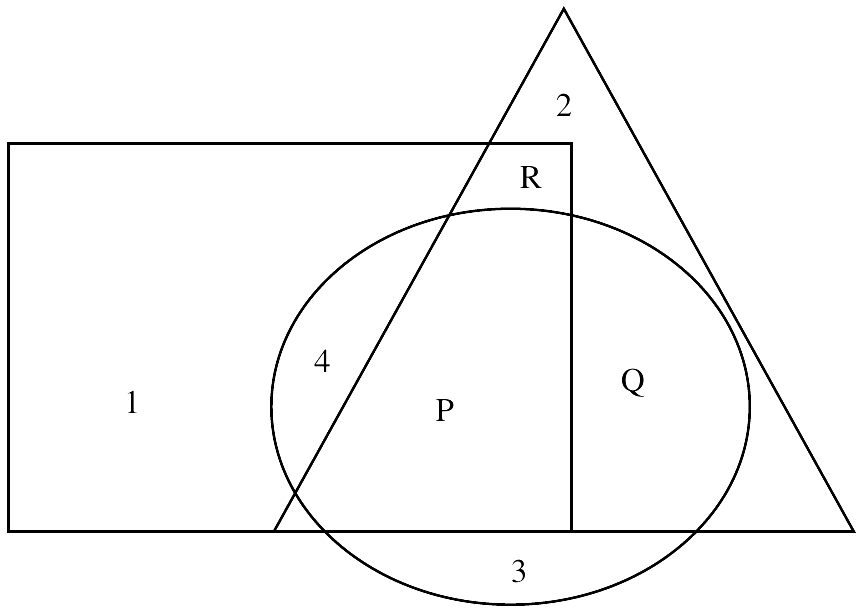
In the given figure, the numbers associated with the rectangle, triangle, and ellipse are 1, 2, and 3, respectively. Which one among the given options is the most appropriate combination of P, Q, and R ?

A rectangle, a triangle and an ellipse overlap. The region inside the rectangle only is marked 1, inside the triangle only 2, inside the ellipse only 3, and inside the rectangle and the ellipse but outside the triangle 4; P marks the region inside all three shapes, Q the region inside the triangle and the ellipse but outside the rectangle, and R the region inside the rectangle and the triangle but outside the ellipse.
Options for Question 4

Explanation

Answer: (A)

Each region carries the sum of the numbers of the shapes it lies in. The given label 4 confirms the rule: that region is inside the rectangle and the ellipse but outside the triangle, and \(1 + 3 = 4\).

  • P is inside all three shapes: \(P = 1 + 2 + 3 = 6\).
  • Q is inside the triangle and the ellipse only: \(Q = 2 + 3 = 5\).
  • R is inside the rectangle and the triangle only: \(R = 1 + 2 = 3\).

Answer: A

Question 5

MCQ · 1 mark · −0.33

A rectangle has a length L and a width W, where L > W. If the width, W, is increased by 10%, which one of the following statements is correct for all values of L and W?

Options for Question 5

Explanation

Answer: (C)

The new width is \(1.1W\), while the length stays \(L\).

  • Area: \(L \times 1.1W = 1.1LW\), exactly 10% more for every \(L\) and \(W\).
  • Perimeter: it grows by \(0.2W\), which is less than 10% of \(2(L + W)\) because the length does not grow.
  • Diagonal: \(\sqrt{L^{2} + 1.21W^{2}} \lt 1.1\sqrt{L^{2} + W^{2}}\), so it also grows by less than 10%.
  • Square: only if \(1.1W = L\), which holds for one particular ratio, not for all values.

Answer: C

Question 6

MCQ · 2 marks · −0.66

Column-I has statements made by Shanthala; and, Column-II has responses given by Kanishk.

Column-IColumn-II
P. This house is in a mess.1. Alright, I won’t bring it up during our conversations.
Q. I am not happy with the marks given to me.2. Well, you can easily look it up.
R. Politics is a subject I avoid talking about.3. No problem, let me clear it up for you.
S. I don’t know what this word means.4. Don’t worry, I will take it up with your teacher.

Identify the option that has the correct match between Column-I and Column-II.

Options for Question 6

Explanation

Answer: (B)

Each response uses a phrasal verb with “up”, and each verb suits exactly one statement:

  • P – 3: a house in a mess needs to be cleared up, that is, tidied.
  • Q – 4: a complaint about marks is taken up (raised) with the teacher.
  • R – 1: to someone who avoids politics, Kanishk promises not to bring it up (mention it).
  • S – 2: an unknown word can be looked up in a dictionary.

This matching is P – 3; Q – 4; R – 1; S – 2.

Answer: B

Question 7

MCQ · 2 marks · −0.66

Weight of a person can be expressed as a function of their age. The function usually varies from person to person. Suppose this function is identical for two brothers, and it monotonically increases till the age of 50 years and then it monotonically decreases. Let \(a_{1}\) and \(a_{2}\) (in years) denote the ages of the brothers and \(a_{1} \lt a_{2}\).

Which one of the following statements is correct about their age on the day when they attain the same weight?

Options for Question 7

Explanation

Answer: (B)

Let \(w\) be the common weight function, taken as strictly increasing up to age 50 and strictly decreasing after it, so its single peak is at 50.

  • If both ages are at most 50, then \(a_{1} \lt a_{2}\) gives \(w(a_{1}) \lt w(a_{2})\).
  • If both ages are at least 50, then \(w(a_{1}) \gt w(a_{2})\).

Either way the weights differ. These two cases cover options A and C, and also D, because an age of exactly 50 falls into one of them. Equal weights are therefore possible only with the ages on opposite sides of the peak: \(a_{1} \lt 50 \lt a_{2}\).

Answer: B

Question 8

MCQ · 2 marks · −0.66

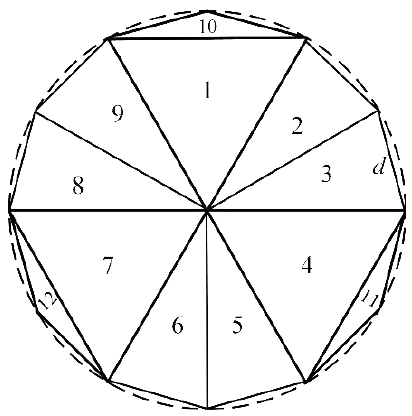
A regular dodecagon (12-sided regular polygon) is inscribed in a circle of radius \(r\) cm as shown in the figure. The side of the dodecagon is \(d\) cm. All the triangles (numbered 1 to 12) in the figure are used to form squares of side \(r\) cm and each numbered triangle is used only once to form a square.

The number of squares that can be formed and the number of triangles required to form each square, respectively, are:

Note: The figure shown is representative.

A regular dodecagon inside a dashed circle, divided into 12 numbered triangles. Triangles 1 to 9 meet at the centre (1, 4 and 7 each reach out to a chord that skips one vertex, the others to a single side), and the small triangles 10, 11 and 12 fill the gaps between those three chords and the dodecagon’s sides; one side is marked d.
Options for Question 8

Explanation

Answer: (A)

Joining the centre to the vertices gives three kinds of triangles:

  • 1, 4, 7: a 60° angle at the centre, so equilateral with side \(r\); area \(\frac{\sqrt{3}}{4}r^{2}\).
  • 2, 3, 5, 6, 8, 9: sides \(r\) and \(r\) with 30° between them; area \(\frac{1}{2}r^{2}\sin 30^\circ = \frac{r^{2}}{4}\).
  • 10, 11, 12: sides \(d\) and \(d\) with the dodecagon’s 150° angle; area \(\frac{d^{2}}{4} = \frac{(2 - \sqrt{3})r^{2}}{4}\), since \(d^{2} = 2r^{2}(1 - \cos 30^\circ)\).

The total area is \(3r^{2}\), so 3 squares of side \(r\). One equilateral, two 30° and one small triangle add up to exactly \(r^{2}\), and they fit: the equilateral triangle stands on one side of the square, the 30° triangles fill the spaces beside it, and the small triangle closes the gap at the opposite side. So each square uses 4 triangles.

Answer: A

Question 9

MCQ · 2 marks · −0.66

If a real variable \(x\) satisfies \(3^{x^{2}} = 27 \times 9^{x}\), then the value of \(\dfrac{2^{x^{2}}}{(2^{x})^{2}}\) is:

Options for Question 9

Explanation

Answer: (C)

Write the right side as a power of 3: \(27 \times 9^{x} = 3^{3} \times 3^{2x} = 3^{2x + 3}\). Equating exponents gives \(x^{2} = 2x + 3\), that is, \(x^{2} - 2x = 3\).

The required value is \(\dfrac{2^{x^{2}}}{(2^{x})^{2}} = \dfrac{2^{x^{2}}}{2^{2x}} = 2^{x^{2} - 2x} = 2^{3}\).

There is no need to find \(x\): both roots, \(x = 3\) and \(x = -1\), satisfy \(x^{2} - 2x = 3\). Adding the exponents instead of subtracting them (with \(x = 3\)) would give the wrong option \(2^{15}\).

Answer: C

Question 10

MCQ · 2 marks · −0.66

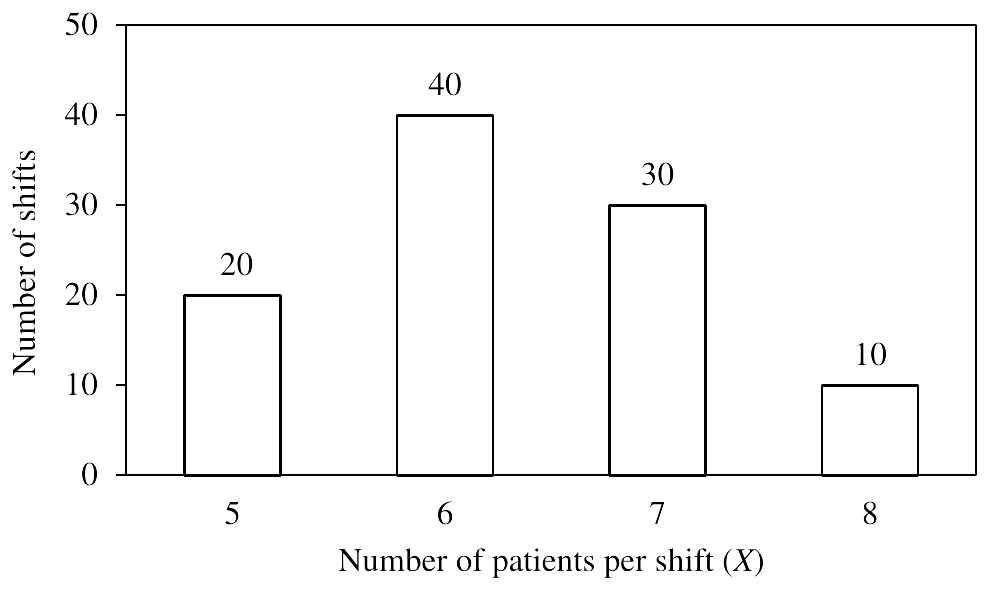
The number of patients per shift (\(X\)) consulting Dr. Gita in her past 100 shifts is shown in the figure. If the amount she earns is ₹ \(1000(X - 0.2)\), what is the average amount (in ₹) she has earned per shift in the past 100 shifts?

Note: The figure shown is representative.

Bar chart with the number of patients per shift (X) on the horizontal axis and the number of shifts (0 to 50) on the vertical axis: 20 shifts had 5 patients, 40 shifts had 6, 30 shifts had 7 and 10 shifts had 8.
Options for Question 10

Explanation

Answer: (A)

From the chart, 20 shifts had 5 patients, 40 had 6, 30 had 7 and 10 had 8, a total of 100 shifts. They saw \(5(20) + 6(40) + 7(30) + 8(10) = 630\) patients, so the mean per shift is \(\bar{X} = \frac{630}{100} = 6.3\).

The earning \(1000(X - 0.2)\) is a linear function of \(X\), so its average is the same function of the average: \(1000(6.3 - 0.2) = 6100\), that is, ₹ 6,100. Forgetting the \(-0.2\) gives 6,300, option B.

Answer: A

Questions 1 to 10 of 65