Analytical Aptitude

GATE DA previous year questions · 2 questions

GATE DA 2025 | Question 4

MCQ · 1 mark · −0.33

In the given figure, the numbers associated with the rectangle, triangle, and ellipse are 1, 2, and 3, respectively. Which one among the given options is the most appropriate combination of P, Q, and R ?
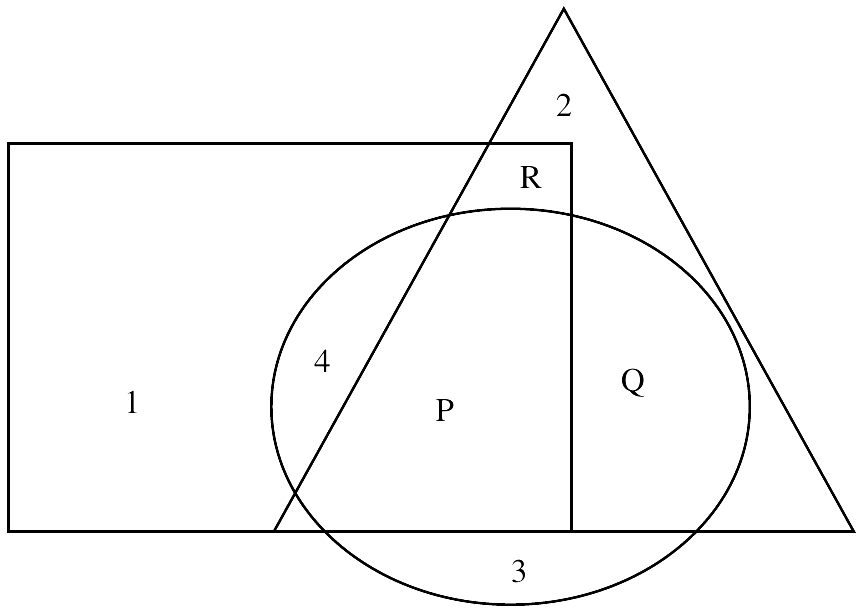
A rectangle, a triangle and an ellipse overlap. The region inside the rectangle only is marked 1, inside the triangle only 2, inside the ellipse only 3, and inside the rectangle and the ellipse but outside the triangle 4; P marks the region inside all three shapes, Q the region inside the triangle and the ellipse but outside the rectangle, and R the region inside the rectangle and the triangle but outside the ellipse.
Options for GATE DA 2025 | Question 4

Explanation

Answer: (A)

Each region carries the sum of the numbers of the shapes it lies in. The given label 4 confirms the rule: that region is inside the rectangle and the ellipse but outside the triangle, and \(1 + 3 = 4\).

  • P is inside all three shapes: \(P = 1 + 2 + 3 = 6\).
  • Q is inside the triangle and the ellipse only: \(Q = 2 + 3 = 5\).
  • R is inside the rectangle and the triangle only: \(R = 1 + 2 = 3\).

Answer: A

GATE DA 2025 | Question 7

MCQ · 2 marks · −0.66

Weight of a person can be expressed as a function of their age. The function usually varies from person to person. Suppose this function is identical for two brothers, and it monotonically increases till the age of 50 years and then it monotonically decreases. Let \(a_{1}\) and \(a_{2}\) (in years) denote the ages of the brothers and \(a_{1} \lt a_{2}\).

Which one of the following statements is correct about their age on the day when they attain the same weight?

Options for GATE DA 2025 | Question 7

Explanation

Answer: (B)

Let \(w\) be the common weight function, taken as strictly increasing up to age 50 and strictly decreasing after it, so its single peak is at 50.

  • If both ages are at most 50, then \(a_{1} \lt a_{2}\) gives \(w(a_{1}) \lt w(a_{2})\).
  • If both ages are at least 50, then \(w(a_{1}) \gt w(a_{2})\).

Either way the weights differ. These two cases cover options A and C, and also D, because an age of exactly 50 falls into one of them. Equal weights are therefore possible only with the ages on opposite sides of the peak: \(a_{1} \lt 50 \lt a_{2}\).

Answer: B