Quantitative Aptitude

GATE DA previous year questions · 9 questions

GATE DA 2025 | Question 3

MCQ · 1 mark · −0.33

A \(4 \times 4\) digital image has pixel intensities (\(U\)) as shown in the figure. The number of pixels with \(U \le 4\) is:

0102
4733
5544
6732
Options for GATE DA 2025 | Question 3

Explanation

Answer: (C)

The condition \(U \le 4\) includes 4, so count every pixel with value 0, 1, 2, 3 or 4, row by row:

  • Row 1 (0, 1, 0, 2): all 4 pixels
  • Row 2 (4, 7, 3, 3): 3 pixels
  • Row 3 (5, 5, 4, 4): 2 pixels
  • Row 4 (6, 7, 3, 2): 2 pixels

The total is \(4 + 3 + 2 + 2 = 11\). As a check, only five pixels are above 4 (5, 5, 6, 7, 7), and \(16 - 5 = 11\). Leaving out the three pixels equal to 4 would give 8, option B.

Answer: C
GATE DA 2025 | Question 5

MCQ · 1 mark · −0.33

A rectangle has a length L and a width W, where L > W. If the width, W, is increased by 10%, which one of the following statements is correct for all values of L and W?

Options for GATE DA 2025 | Question 5

Explanation

Answer: (C)

The new width is \(1.1W\), while the length stays \(L\).

  • Area: \(L \times 1.1W = 1.1LW\), exactly 10% more for every \(L\) and \(W\).
  • Perimeter: it grows by \(0.2W\), which is less than 10% of \(2(L + W)\) because the length does not grow.
  • Diagonal: \(\sqrt{L^{2} + 1.21W^{2}} \lt 1.1\sqrt{L^{2} + W^{2}}\), so it also grows by less than 10%.
  • Square: only if \(1.1W = L\), which holds for one particular ratio, not for all values.

Answer: C

GATE DA 2025 | Question 9

MCQ · 2 marks · −0.66

If a real variable \(x\) satisfies \(3^{x^{2}} = 27 \times 9^{x}\), then the value of \(\dfrac{2^{x^{2}}}{(2^{x})^{2}}\) is:

Options for GATE DA 2025 | Question 9

Explanation

Answer: (C)

Write the right side as a power of 3: \(27 \times 9^{x} = 3^{3} \times 3^{2x} = 3^{2x + 3}\). Equating exponents gives \(x^{2} = 2x + 3\), that is, \(x^{2} - 2x = 3\).

The required value is \(\dfrac{2^{x^{2}}}{(2^{x})^{2}} = \dfrac{2^{x^{2}}}{2^{2x}} = 2^{x^{2} - 2x} = 2^{3}\).

There is no need to find \(x\): both roots, \(x = 3\) and \(x = -1\), satisfy \(x^{2} - 2x = 3\). Adding the exponents instead of subtracting them (with \(x = 3\)) would give the wrong option \(2^{15}\).

Answer: C

GATE DA 2025 | Question 10

MCQ · 2 marks · −0.66

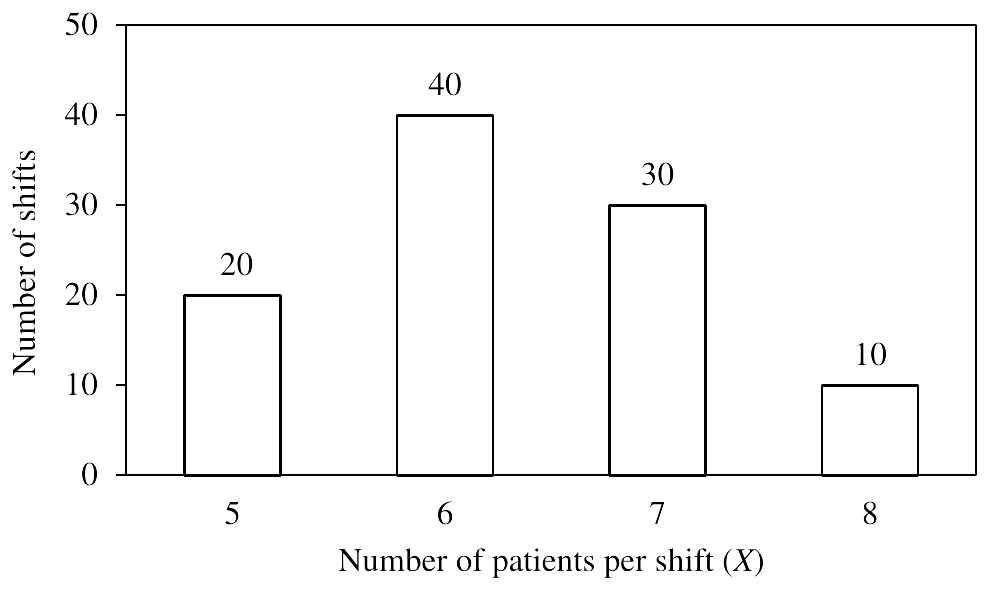
The number of patients per shift (\(X\)) consulting Dr. Gita in her past 100 shifts is shown in the figure. If the amount she earns is ₹ \(1000(X - 0.2)\), what is the average amount (in ₹) she has earned per shift in the past 100 shifts?

Note: The figure shown is representative.

Bar chart with the number of patients per shift (X) on the horizontal axis and the number of shifts (0 to 50) on the vertical axis: 20 shifts had 5 patients, 40 shifts had 6, 30 shifts had 7 and 10 shifts had 8.
Options for GATE DA 2025 | Question 10

Explanation

Answer: (A)

From the chart, 20 shifts had 5 patients, 40 had 6, 30 had 7 and 10 had 8, a total of 100 shifts. They saw \(5(20) + 6(40) + 7(30) + 8(10) = 630\) patients, so the mean per shift is \(\bar{X} = \frac{630}{100} = 6.3\).

The earning \(1000(X - 0.2)\) is a linear function of \(X\), so its average is the same function of the average: \(1000(6.3 - 0.2) = 6100\), that is, ₹ 6,100. Forgetting the \(-0.2\) gives 6,300, option B.

Answer: A

GATE DA 2024 | Question 3

MCQ · 1 mark · −0.33

How many 4-digit positive integers divisible by 3 can be formed using only the digits \(\{1, 3, 4, 6, 7\}\), such that no digit appears more than once in a number?

Options for GATE DA 2024 | Question 3

Explanation

Answer: (B)

A number is divisible by 3 exactly when its digit sum is. The five digits add up to \(1 + 3 + 4 + 6 + 7 = 21\), and a 4-digit number with distinct digits from this set leaves out exactly one digit, so its digit sum is 21 minus the digit left out.

That is a multiple of 3 only when the digit left out is a multiple of 3, i.e. 3 or 6. Each choice leaves four distinct non-zero digits, which can be arranged in \(4! = 24\) ways.

Total \(= 2 \times 24 = 48\).

Answer: B

GATE DA 2024 | Question 4

MCQ · 1 mark · −0.33

The sum of the following infinite series is

\[2 + \frac{1}{2} + \frac{1}{3} + \frac{1}{4} + \frac{1}{8} + \frac{1}{9} + \frac{1}{16} + \frac{1}{27} + \cdots\]

Options for GATE DA 2024 | Question 4

Explanation

Answer: (B)

After the leading 2, the terms are two geometric series interleaved: the powers of \(\tfrac{1}{2}\) (\(\tfrac{1}{2}, \tfrac{1}{4}, \tfrac{1}{8}, \tfrac{1}{16}, \ldots\)) and the powers of \(\tfrac{1}{3}\) (\(\tfrac{1}{3}, \tfrac{1}{9}, \tfrac{1}{27}, \ldots\)). All terms are positive, so they may be regrouped. With \(\frac{a}{1 - r}\) for each series:

\[\frac{1/2}{1 - 1/2} = 1, \qquad \frac{1/3}{1 - 1/3} = \frac{1}{2}.\]

Sum \(= 2 + 1 + \tfrac{1}{2} = \tfrac{7}{2}\).

Answer: B

GATE DA 2024 | Question 5

MCQ · 1 mark · −0.33

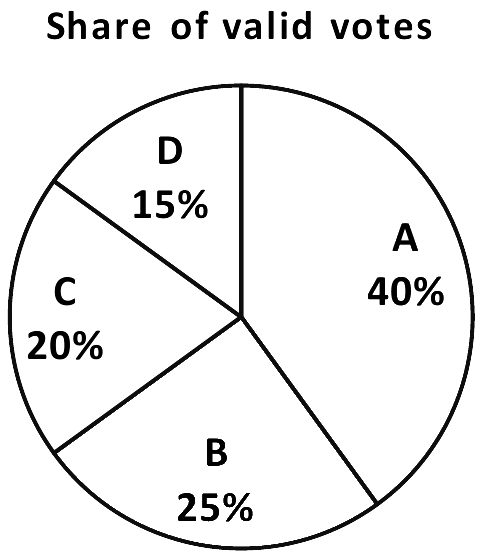
In an election, the share of valid votes received by the four candidates A, B, C, and D is represented by the pie chart shown. The total number of votes cast in the election were 1,15,000, out of which 5,000 were invalid.

Pie chart titled “Share of valid votes”: A 40%, B 25%, C 20% and D 15%.

Based on the data provided, the total number of valid votes received by the candidates B and C is

Options for GATE DA 2024 | Question 5

Explanation

Answer: (B)

The chart shows shares of the valid votes, so remove the invalid ones first: 1,15,000 − 5,000 = 1,10,000 valid votes.

B and C together hold 25% + 20% = 45% of these: 0.45 × 1,10,000 = 49,500.

Option (C), 51,750, is the trap of taking 45% of all 1,15,000 votes cast, including the invalid ones.

Answer: B

GATE DA 2024 | Question 7

MCQ · 2 marks · −0.66

The probability of a boy or a girl being born is 1/2. For a family having only three children, what is the probability of having two girls and one boy?

Options for GATE DA 2024 | Question 7

Explanation

Answer: (A)

Each of the three children is independently a boy or a girl with probability \(\tfrac{1}{2}\), so all \(2^{3} = 8\) ordered outcomes are equally likely.

Two girls and one boy happens as GGB, GBG or BGG: \(\binom{3}{1} = 3\) outcomes, one for each choice of which child is the boy. The probability is \(\tfrac{3}{8}\).

The tempting \(\tfrac{1}{8}\) counts only one particular birth order.

Answer: A

GATE DA 2024 | Question 8

MCQ · 2 marks · −0.66

Person 1 and Person 2 invest in three mutual funds A, B, and C. The amounts they invest in each of these mutual funds are given in the table.

Mutual fund AMutual fund BMutual fund C
Person 1₹10,000₹20,000₹20,000
Person 2₹20,000₹15,000₹15,000

At the end of one year, the total amount that Person 1 gets is ₹500 more than Person 2. The annual rate of return for the mutual funds B and C is 15% each. What is the annual rate of return for the mutual fund A?

Options for GATE DA 2024 | Question 8

Explanation

Answer: (B)

Let the annual return of fund A be \(r\). Each person invests ₹50,000 in total, so it is enough to compare the returns.

  • Person 1: \(10{,}000r + 0.15 \times 40{,}000 = 10{,}000r + 6{,}000\)
  • Person 2: \(20{,}000r + 0.15 \times 30{,}000 = 20{,}000r + 4{,}500\)

Person 1 gets ₹500 more, so \((10{,}000r + 6{,}000) - (20{,}000r + 4{,}500) = 500\), which gives \(1{,}500 - 10{,}000r = 500\) and \(r = 0.10\), i.e. 10%.

Answer: B