GATE DA 2025 | Question 8
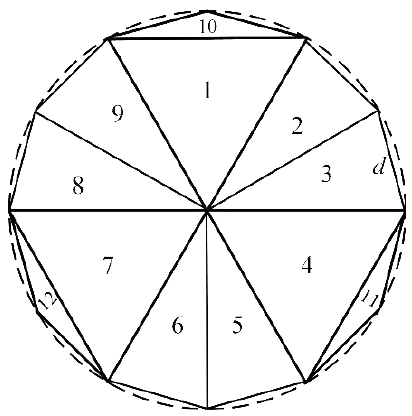
A regular dodecagon (12-sided regular polygon) is inscribed in a circle of radius \(r\) cm as shown in the figure. The side of the dodecagon is \(d\) cm. All the triangles (numbered 1 to 12) in the figure are used to form squares of side \(r\) cm and each numbered triangle is used only once to form a square.
The number of squares that can be formed and the number of triangles required to form each square, respectively, are:
Note: The figure shown is representative.
Explanation
Answer: (A)
Joining the centre to the vertices gives three kinds of triangles:
- 1, 4, 7: a 60° angle at the centre, so equilateral with side \(r\); area \(\frac{\sqrt{3}}{4}r^{2}\).
- 2, 3, 5, 6, 8, 9: sides \(r\) and \(r\) with 30° between them; area \(\frac{1}{2}r^{2}\sin 30^\circ = \frac{r^{2}}{4}\).
- 10, 11, 12: sides \(d\) and \(d\) with the dodecagon’s 150° angle; area \(\frac{d^{2}}{4} = \frac{(2 - \sqrt{3})r^{2}}{4}\), since \(d^{2} = 2r^{2}(1 - \cos 30^\circ)\).
The total area is \(3r^{2}\), so 3 squares of side \(r\). One equilateral, two 30° and one small triangle add up to exactly \(r^{2}\), and they fit: the equilateral triangle stands on one side of the square, the 30° triangles fill the spaces beside it, and the small triangle closes the gap at the opposite side. So each square uses 4 triangles.
Answer: A