Consider the following logic circuit diagram.
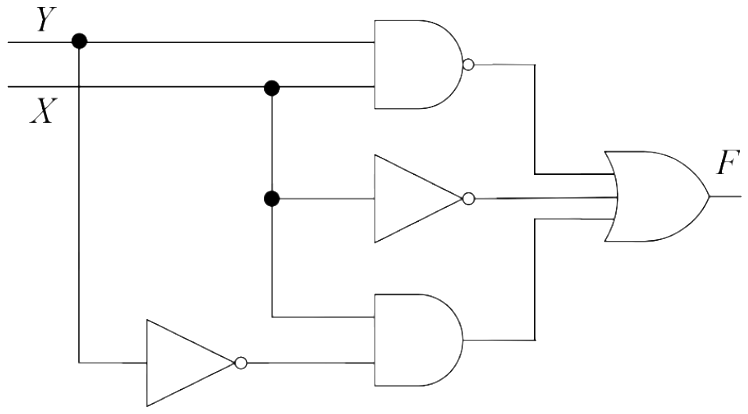
Which is/are the CORRECT option(s) for the output function \(F\)?
Answer
(A), (B), (C)
Explanation
Reading the three gates that feed the OR gate:
- the NAND gate gives \(\overline{XY}\);
- the NOT gate on \(X\) gives \(\overline{X}\);
- the AND gate gives \(X\overline{Y}\).
So \(F = \overline{XY} + \overline{X} + X\overline{Y}\), which is option C as written. By De Morgan's law \(\overline{XY} = \overline{X} + \overline{Y}\); the term \(\overline{X}\) repeats part of this and \(X\overline{Y}\) is absorbed by \(\overline{Y}\), so \(F = \overline{X} + \overline{Y} = \overline{XY}\). That is option A, and option B reduces to it the same way.
D is wrong: at \(X = Y = 1\), \(F = 0\) but \(X + \overline{Y} = 1\).
Answer: A, B, C