Digital Logic

GATE CS previous year questions · 17 questions

Topics

GATE CS 2025 Set 1 | Question 24

MSQ · 1 mark

Let \(X\) be a 3-variable Boolean function that produces output as ‘1’ when at least two of the input variables are ‘1’. Which of the following statement(s) is/are CORRECT, where \(a, b, c, d, e\) are Boolean variables?

Options for GATE CS 2025 Set 1 | Question 24

Explanation

Answer: (B), (D)

\(X\) is the majority function. Two quick rules: \(X(p, p, r) = p\), and if two arguments differ, \(X\) equals the remaining one.

  • (A) False: with \(a = b = 1\), \(c = d = e = 0\), the left side is \(X(1, 1, 0) = 1\) but the right side is \(X(1, 0, 0) = 0\).
  • (B) True: if \(a = b\), both sides equal \(a\); if \(a \ne b\), the left side equals its third argument, \(X(a, b, c)\).
  • (C) False: the right side is \(a \cdot c\); with \(a = b = 1\), \(c = d = 0\), the left side is \(X(1, 1, 0) = 1\) but the right side is 0.
  • (D) True: \(X(a, c, c) = c\), so the right side is \(X(a, X(a, b, c), c)\); if \(a = c\) it equals \(a = X(a, b, c)\), and if \(a \ne c\) it equals the middle argument \(X(a, b, c)\).

Answer: B, D
GATE CS 2025 Set 1 | Question 25

MSQ · 1 mark

The number −6 can be represented as 1010 in 4-bit 2’s complement representation. Which of the following is/are CORRECT 2’s complement representation(s) of −6?

Options for GATE CS 2025 Set 1 | Question 25

Explanation

Answer: (B), (D)

To widen a 2’s complement number, copy its sign bit into every new position (sign extension). The sign bit of 1010 is 1, so \(-6\) is 1111 1010 in 8 bits and 1111 1111 1111 1010 in 16 bits.

  • (A) False: 1000 1010 is \(-128 + 10 = -118\).
  • (B) True: 1111 1010 is \(-128 + 122 = -6\).
  • (C) False: 1000 0000 0000 1010 is \(-32768 + 10 = -32758\).
  • (D) True: it is 1010 sign-extended to 16 bits, value \(-6\).

Answer: B, D

GATE CS 2025 Set 1 | Question 42

MCQ · 2 marks · −0.66

Consider the following four variable Boolean function in sum-of-product form

\[ F(b_3, b_2, b_1, b_0) = \sum (0, 2, 4, 8, 10, 11, 12). \]

where the value of the function is computed by considering \(b_3 b_2 b_1 b_0\) as a 4-bit binary number, where \(b_3\) denotes the most significant bit and \(b_0\) denotes the least significant bit. Note that there are no don’t care terms. Which ONE of the following options is the CORRECT minimized Boolean expression for \(F\)?

Options for GATE CS 2025 Set 1 | Question 42

Explanation

Answer: (A)

Write the minterms as \(b_3 b_2 b_1 b_0\): 0 = 0000, 2 = 0010, 4 = 0100, 8 = 1000, 10 = 1010, 11 = 1011, 12 = 1100. Group them on a K-map:

  • \(\{0, 4, 8, 12\}\) all have \(b_1 = b_0 = 0\), giving \(\bar{b}_1 \bar{b}_0\).
  • \(\{0, 2, 8, 10\}\) all have \(b_2 = b_0 = 0\), giving \(\bar{b}_2 \bar{b}_0\).
  • 11 (1011) has only one neighbouring 1, namely 10 (1010), so it needs the pair \(\{10, 11\}\), giving \(b_3 \bar{b}_2 b_1\).

All three groups are essential and together cover exactly the seven minterms, so \(F = \bar{b}_1 \bar{b}_0 + \bar{b}_2 \bar{b}_0 + b_1 \bar{b}_2 b_3\). Option B misses minterm 11, C covers 14 and 15 (not in \(F\)), and D covers 1, 3, 5, 6 and 7.

Answer: A

GATE CS 2025 Set 1 | Question 60

NAT · 2 marks

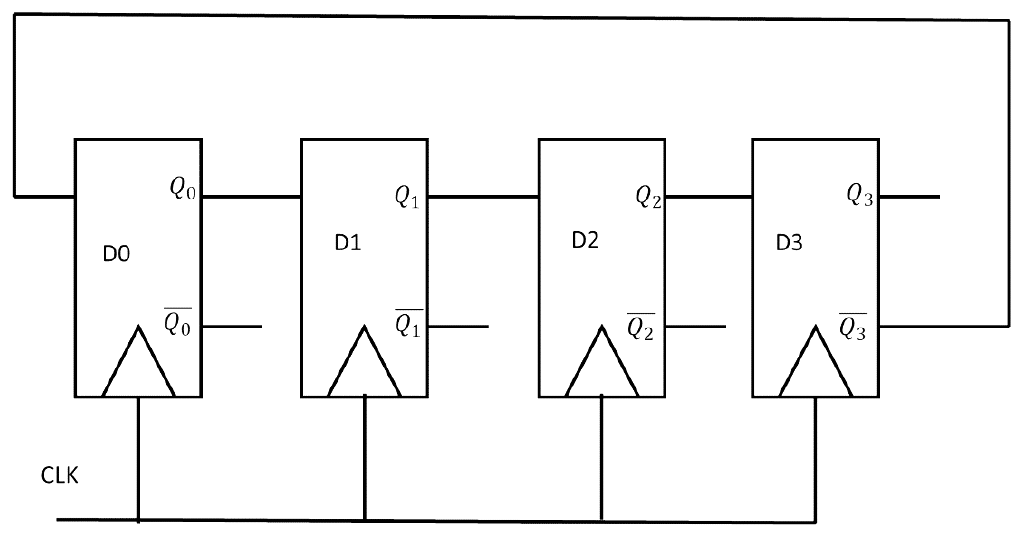
Consider the given sequential circuit designed using D-Flip-flops. The circuit is initialized with some value (initial state). The number of distinct states the circuit will go through before returning back to the initial state is _________ . (Answer in integer)

Four D flip-flops D0 to D3 on a common clock: Q0 drives D1, Q1 drives D2, Q2 drives D3, and the complemented output of D3 feeds back to D0

Explanation

Answer: 7 to 8

From the circuit, \(D_1 = Q_0\), \(D_2 = Q_1\), \(D_3 = Q_2\) and \(D_0 = \overline{Q_3}\). Each clock shifts the bits one place and feeds the complement of the last bit back to the first: a 4-bit Johnson (twisted-ring) counter.

With the state written as \(Q_0Q_1Q_2Q_3\): 0000 → 1000 → 1100 → 1110 → 1111 → 0111 → 0011 → 0001 → 0000. The other 8 states form a second cycle of the same length (0100 → 1010 → 1101 → 0110 → 1011 → 0101 → 0010 → 1001 → 0100), so from any initial state the circuit comes back after 8 clocks.

That is 8 distinct states counting the initial one, or 7 besides it, so the official key accepts 7 to 8.

Answer: 8 (7 is also accepted)

GATE CS 2025 Set 2 | Question 31

MSQ · 1 mark

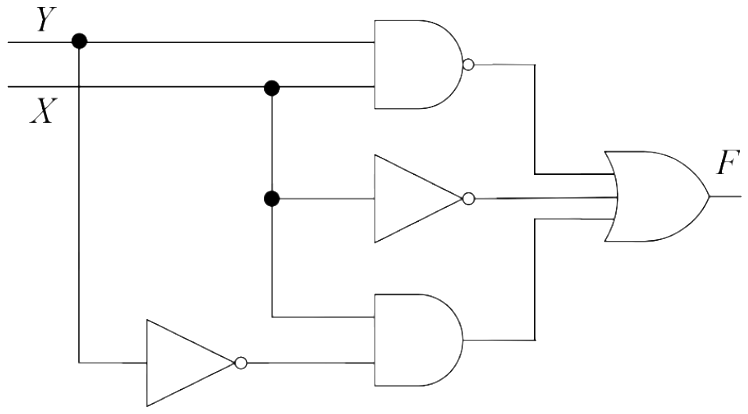
Consider the following logic circuit diagram.

Logic circuit with inputs Y and X. A NAND gate takes Y and X, a NOT gate takes X, and an AND gate takes X and Y passed through a NOT gate; the outputs of these three gates are the inputs of an OR gate whose output is F.

Which is/are the CORRECT option(s) for the output function \(F\)?

Options for GATE CS 2025 Set 2 | Question 31

Explanation

Answer: (A), (B), (C)

Reading the three gates that feed the OR gate:

  • the NAND gate gives \(\overline{XY}\);
  • the NOT gate on \(X\) gives \(\overline{X}\);
  • the AND gate gives \(X\overline{Y}\).

So \(F = \overline{XY} + \overline{X} + X\overline{Y}\), which is option C as written. By De Morgan's law \(\overline{XY} = \overline{X} + \overline{Y}\); the term \(\overline{X}\) repeats part of this and \(X\overline{Y}\) is absorbed by \(\overline{Y}\), so \(F = \overline{X} + \overline{Y} = \overline{XY}\). That is option A, and option B reduces to it the same way.

D is wrong: at \(X = Y = 1\), \(F = 0\) but \(X + \overline{Y} = 1\).

Answer: A, B, C

GATE CS 2025 Set 2 | Question 34

NAT · 1 mark

In a 4-bit ripple counter, if the period of the waveform at the last flip-flop is 64 microseconds, then the frequency of the ripple counter in kHz is ________. (Answer in integer)

Explanation

Answer: 250

Each flip-flop in a ripple counter toggles on every active edge it receives, so its output completes one cycle for every two input cycles: each stage halves the frequency. The output of the 4th (last) flip-flop therefore runs at \(f_{clk}/2^{4} = f_{clk}/16\), and its period is 16 clock periods.

\(16\,T_{clk} = 64\ \mu\text{s} \Rightarrow T_{clk} = 4\ \mu\text{s} \Rightarrow f_{clk} = \frac{1}{4\ \mu\text{s}} = 250\ \text{kHz}\).

The counter’s frequency is its input clock frequency. Taking the last stage’s own frequency, \(1/64\ \mu\text{s} \approx 15.6\) kHz, is the usual slip.

Answer: 250

GATE CS 2025 Set 2 | Question 43

MSQ · 2 marks

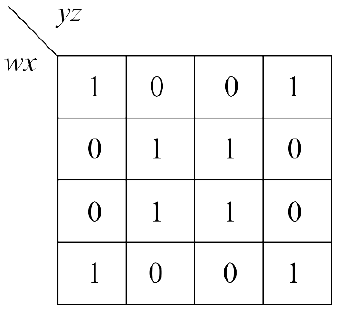
Given the following Karnaugh Map for a Boolean function \(F(w, x, y, z)\):

Four-variable Karnaugh map with wx labelling the rows and yz labelling the columns; the individual rows and columns carry no labels. The rows read, from top to bottom: 1 0 0 1, 0 1 1 0, 0 1 1 0, 1 0 0 1.

Which one or more of the following Boolean expression(s) represent(s) \(F\)?

Options for GATE CS 2025 Set 2 | Question 43

Explanation

Answer: (A), (D)

Read the map with the usual Gray-code order (00, 01, 11, 10) for \(wx\) and \(yz\). The four corner 1s are the cells with \(x = 0, z = 0\), and the central block of four 1s has \(x = 1, z = 1\). So \(F = \overline{x}\,\overline{z} + xz\), which is option D.

  • A: its four 4-literal terms are exactly the four corner cells, and \(\overline{x}\,\overline{z}(\overline{w}\,\overline{y} + w\overline{y} + \overline{w}y + wy) = \overline{x}\,\overline{z}\), so A equals D.
  • B: \(w\overline{x}yz\) has \(x = 0, z = 1\), a 0 cell, and two corner cells are missing.
  • C: \(w\overline{x}\,\overline{y}z\) is also a 0 cell, and two corner cells are missing.

Answer: A, D

GATE CS 2025 Set 2 | Question 49

MSQ · 2 marks

Three floating point numbers \(X, Y\), and \(Z\) are stored in three registers RX, RY, and RZ, respectively in IEEE 754 single precision format as given below in hexadecimal:

RX = 0xC1100000, RY = 0x40C00000, and RZ = 0x41400000

Which of the following option(s) is/are CORRECT?

Options for GATE CS 2025 Set 2 | Question 49

Explanation

Answer: (A), (B), (C)

Read each word as sign (1 bit), biased exponent (8 bits) and fraction (23 bits); the value is \((-1)^{s} \times 1.f \times 2^{e - 127}\).

  • 0xC1100000: sign 1, exponent 10000010 = 130, fraction 001000…, so \(X = -1.125 \times 2^{3} = -9\).
  • 0x40C00000: sign 0, exponent 10000001 = 129, fraction 100000…, so \(Y = 1.5 \times 2^{2} = 6\).
  • 0x41400000: sign 0, exponent 10000010 = 130, fraction 100000…, so \(Z = 1.5 \times 2^{3} = 12\).

Now check each option: (A) \(4(-9 + 6) + 12 = 0\); (B) \(12 - 12 = 0\); (C) \(-36 + 36 = 0\). (D) fails because \(-9 + 6 + 12 = 9\).

Answer: A, B, C

GATE CS 2025 Set 2 | Question 50

MSQ · 2 marks

Which of the following Boolean algebraic equation(s) is/are CORRECT?

Options for GATE CS 2025 Set 2 | Question 50

Explanation

Answer: (B), (C), (D)

  • (A) is wrong. The left side is \(\sum m(0, 3, 4, 5, 7)\) over \(ABC\). On the right, \(B\,C\) gives \(m_3, m_7\), \(\overline{B}\,\overline{C}\) gives \(m_0, m_4\) and \(\overline{A}\,\overline{B}\) gives \(m_0, m_1\): it contains 001 and misses 101. With \(A\,\overline{B}\) as the last term it would hold.
  • (B) is the consensus theorem: \(BC = ABC + \overline{A}BC\), and these two terms are absorbed by \(AB\) and \(\overline{A}C\).
  • (C) Expanding gives \(A\overline{A} + AB + \overline{A}C + BC = AB + \overline{A}C + BC\), which reduces to \(AB + \overline{A}C\) by (B).
  • (D) By De Morgan, the complement of the product is the sum of the complemented factors: \(\overline{A}BD + \overline{C}\,\overline{D} + A\overline{C}\,\overline{D} + \overline{A}\,\overline{B}D\). The first and last terms combine to \(\overline{A}D\), and \(A\overline{C}\,\overline{D}\) is absorbed by \(\overline{C}\,\overline{D}\).

Answer: B, C, D

GATE CS 2024 Set 1 | Question 13

MCQ · 1 mark · −0.33

Consider a system that uses 5 bits for representing signed integers in 2’s complement format. In this system, two integers \(A\) and \(B\) are represented as \(A\)=01010 and \(B\)=11010. Which one of the following operations will result in either an arithmetic overflow or an arithmetic underflow?

Options for GATE CS 2024 Set 1 | Question 13

Explanation

Answer: (B)

With 5 bits, 2’s complement covers \(-16\) to \(+15\). Decode the operands: \(A = 01010 = +10\), and \(B = 11010 = -6\) (invert and add 1 to get \(00110 = 6\)).

  • \(A + B = 4\): in range.
  • \(A - B = 10 + 6 = 16\): above \(+15\), so it overflows; the 5-bit result 10000 would read as \(-16\).
  • \(B - A = -16\): exactly the most negative value, so it fits.
  • \(2 * B = -12\): in range.

Only \(A - B\) leaves the representable range.

Answer: B