Given the following Karnaugh Map for a Boolean function \(F(w, x, y, z)\):
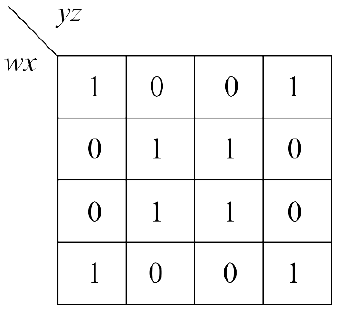
Which one or more of the following Boolean expression(s) represent(s) \(F\)?
Answer
(A), (D)
Explanation
Read the map with the usual Gray-code order (00, 01, 11, 10) for \(wx\) and \(yz\). The four corner 1s are the cells with \(x = 0, z = 0\), and the central block of four 1s has \(x = 1, z = 1\). So \(F = \overline{x}\,\overline{z} + xz\), which is option D.
- A: its four 4-literal terms are exactly the four corner cells, and \(\overline{x}\,\overline{z}(\overline{w}\,\overline{y} + w\overline{y} + \overline{w}y + wy) = \overline{x}\,\overline{z}\), so A equals D.
- B: \(w\overline{x}yz\) has \(x = 0, z = 1\), a 0 cell, and two corner cells are missing.
- C: \(w\overline{x}\,\overline{y}z\) is also a 0 cell, and two corner cells are missing.
Answer: A, D