Digital Logic

GATE CS previous year questions · 17 questions

GATE CS 2024 Set 1 | Question 28

MSQ · 1 mark

Consider the circuit shown below where the gates may have propagation delays. Assume that all signal transitions occur instantaneously and that wires have no delays. Which of the following statements about the circuit is/are CORRECT?
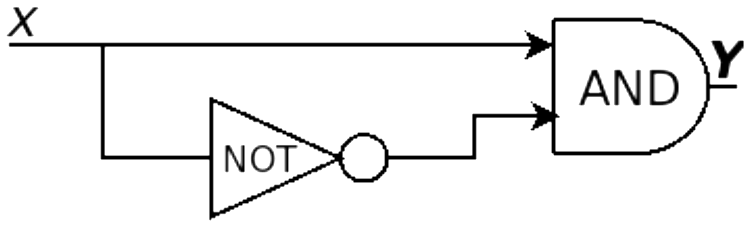
Logic circuit in which input X feeds one input of an AND gate directly and the other input through a NOT gate; the output of the AND gate is Y.
Options for GATE CS 2024 Set 1 | Question 28

Explanation

Answer: (A), (C)

The AND gate receives \(X\) directly and \(\overline{X}\) through the inverter, so ideally \(Y = X \cdot \overline{X} = 0\) for every input: A is true and B is false.

Now let the NOT gate take time \(t\) to respond.

  • \(X\) rises from 0 to 1: the direct input becomes 1 at once, but for time \(t\) the inverter still outputs its old value 1. Both AND inputs are briefly 1, so \(Y\) shows a short glitch to logic One (a static hazard). C is true.
  • \(X\) falls from 1 to 0: the direct input drops to 0 at once, while the inverter output is still 0 and rises only after \(t\). The two inputs are never 1 together, so \(Y\) simply stays at 0. With no 1 to dip from, no transient Zero can appear, so D is false.

Answer: A, C
GATE CS 2024 Set 1 | Question 47

MSQ · 2 marks

Consider a Boolean expression given by \(F(X, Y, Z) = \sum(3,5,6,7)\).

Which of the following statements is/are CORRECT?

Options for GATE CS 2024 Set 1 | Question 47

Explanation

Answer: (A), (B)

  • A is true. The maxterms of a function are exactly the minterms it does not contain; out of 0 to 7 these are 0, 1, 2 and 4.
  • B is true. \(XY + YZ + XZ\) is 1 exactly when at least two inputs are 1, that is for \(XYZ\) = 011, 101, 110 and 111, which are minterms 3, 5, 6 and 7. \(F\) is the 3-input majority function.
  • C and D are false. \(F(X, 0, Z) = XZ\) while \(F(X, 1, Z) = X + Z\), so \(F\) depends on \(Y\). Likewise \(F(0, Y, Z) = YZ\) and \(F(1, Y, Z) = Y + Z\) differ, so \(F\) depends on \(X\).

Answer: A, B

GATE CS 2024 Set 1 | Question 64

NAT · 2 marks

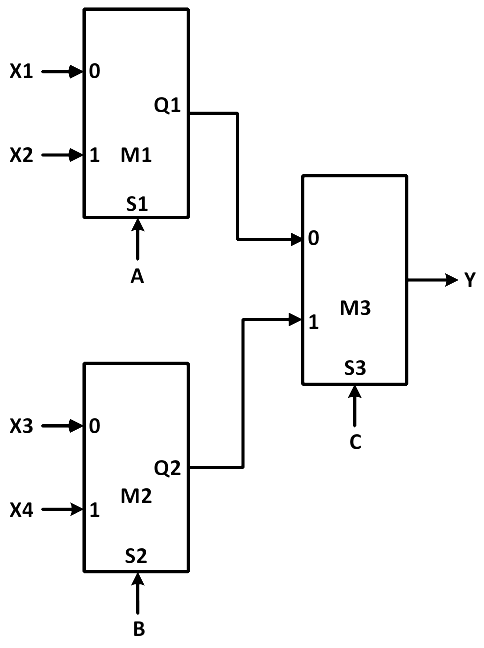
Consider a digital logic circuit consisting of three 2-to-1 multiplexers M1, M2, and M3 as shown below. X1 and X2 are inputs of M1. X3 and X4 are inputs of M2. A, B, and C are select lines of M1, M2, and M3, respectively.

Three 2-to-1 multiplexers. M1 takes X1 on input 0 and X2 on input 1, with select S1 driven by A and output Q1; M2 takes X3 on input 0 and X4 on input 1, with select S2 driven by B and output Q2; Q1 feeds input 0 and Q2 feeds input 1 of M3, whose select S3 is driven by C and whose output is Y.

For an instance of inputs X1=1, X2=1, X3=0, and X4=0, the number of combinations of A, B, C that give the output Y=1 is _________

Explanation

Answer: 4

A 2-to-1 multiplexer passes its input 0 when the select line is 0 and its input 1 when the select line is 1.

  • M1 chooses between X1 = 1 and X2 = 1, so Q1 = 1 whatever A is.
  • M2 chooses between X3 = 0 and X4 = 0, so Q2 = 0 whatever B is.
  • M3 passes Q1 when C = 0 and Q2 when C = 1, so \(Y = \overline{C}\).

Y = 1 exactly when C = 0, while A and B can take any values: \(2 \times 2 = 4\) of the 8 combinations.

Answer: 4

GATE CS 2024 Set 2 | Question 14

MCQ · 1 mark · −0.33

The format of a single-precision floating-point number as per the IEEE 754 standard is:

Sign
(1bit)
Exponent
(8 bits)
Mantissa
(23 bits)

Choose the largest floating-point number among the following options.

Options for GATE CS 2024 Set 2 | Question 14

Explanation

Answer: (B)

All four have sign bit 0, so compare their values using the exponent bias of 127.

  • A: exponent 0111 1111 is 127, so the value is \((2 - 2^{-23}) \times 2^{0}\), just under 2.
  • B: exponent 1111 1110 is 254, so the value is \((2 - 2^{-23}) \times 2^{127}\), about \(3.4 \times 10^{38}\).
  • C: an all-ones exponent is reserved. With a non-zero mantissa the pattern means NaN (not a number), which has no value to compare.
  • D: exponent 127 with a zero mantissa is exactly 1.

B is in fact the largest finite single-precision number, so it is the largest option.

Answer: B

GATE CS 2024 Set 2 | Question 30

MSQ · 1 mark

For a Boolean variable \(x\), which of the following statements is/are FALSE?

Options for GATE CS 2024 Set 2 | Question 30

Explanation

Answer: (B), (C)

Check each statement for \(x = 0\) and \(x = 1\):

  • A: \(x.1 = x\) is the identity law for AND, so it is true.
  • B: \(x + 1 = 1\) for every \(x\), so \(x + 1 = x\) fails when \(x = 0\). False.
  • C: \(x.x = x\) (idempotent law), so \(x.x = 0\) fails when \(x = 1\). False.
  • D: \(x + \overline{x} = 1\) is the complement law, so it is true.

The false statements are B and C.

Answer: B, C

GATE CS 2024 Set 2 | Question 49

MSQ · 2 marks

Which of the following is/are EQUAL to 224 in radix-5 (i.e., base-5) notation?

Options for GATE CS 2024 Set 2 | Question 49

Explanation

Answer: (A), (B), (D)

Convert every numeral to decimal using its place values.

  • \(224_5 = 2 \times 5^{2} + 2 \times 5 + 4 = 50 + 10 + 4 = 64\).
  • (A) \(64_{10} = 64\): equal.
  • (B) \(100_8 = 1 \times 8^{2} = 64\): equal.
  • (C) \(50_{16} = 5 \times 16 = 80\): not equal.
  • (D) \(121_7 = 1 \times 7^{2} + 2 \times 7 + 1 = 49 + 14 + 1 = 64\): equal.

So three of the four numerals name the same value, 64; only the hexadecimal one differs.

Answer: A, B, D

GATE CS 2024 Set 2 | Question 50

MSQ · 2 marks

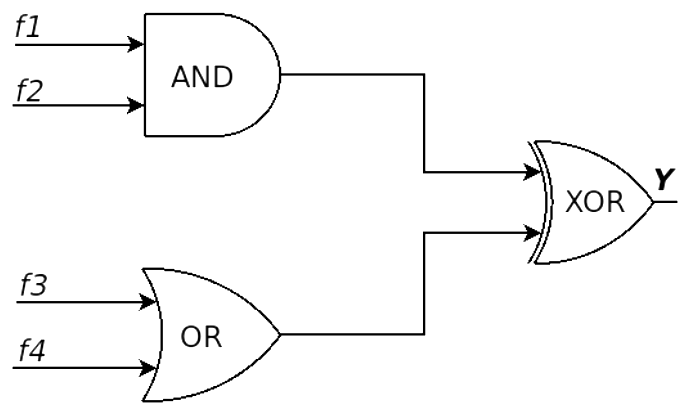
Consider 4-variable functions \(f1, f2, f3, f4\) expressed in sum-of-minterms form as given below.

\(f1 = \sum(0,2,3,5,7,8,11,13)\)
\(f2 = \sum(1,3,5,7,11,13,15)\)
\(f3 = \sum(0,1,4,11)\)
\(f4 = \sum(0,2,6,13)\)

Logic circuit: inputs f1 and f2 enter an AND gate, inputs f3 and f4 enter an OR gate, and the outputs of the AND gate and the OR gate are the two inputs of an XOR gate whose output is Y.

With respect to the circuit given above, which of the following options is/are CORRECT?

Options for GATE CS 2024 Set 2 | Question 50

Explanation

Answer: (C), (D)

Work with minterm sets: AND keeps the minterms common to both inputs, OR takes their union, and XOR keeps the minterms that appear in exactly one input.

  • \(f1 \cdot f2\): common minterms \(\{3, 5, 7, 11, 13\}\).
  • \(f3 + f4\): \(\{0, 1, 2, 4, 6, 11, 13\}\).
  • XOR: 11 and 13 are in both sets and cancel, leaving \(\{0, 1, 2, 3, 4, 5, 6, 7\}\).

So \(Y = \sum(0,1,2,3,4,5,6,7)\), which is (C). Its maxterms are the remaining minterms 8 to 15, so (D) is the same function. Options (A) and (B) both describe \(\sum(0,1,2,11,13)\), which is not \(Y\).

Answer: C, D