Consider 4-variable functions \(f1, f2, f3, f4\) expressed in sum-of-minterms form as given below.
\(f1 = \sum(0,2,3,5,7,8,11,13)\)
\(f2 = \sum(1,3,5,7,11,13,15)\)
\(f3 = \sum(0,1,4,11)\)
\(f4 = \sum(0,2,6,13)\)
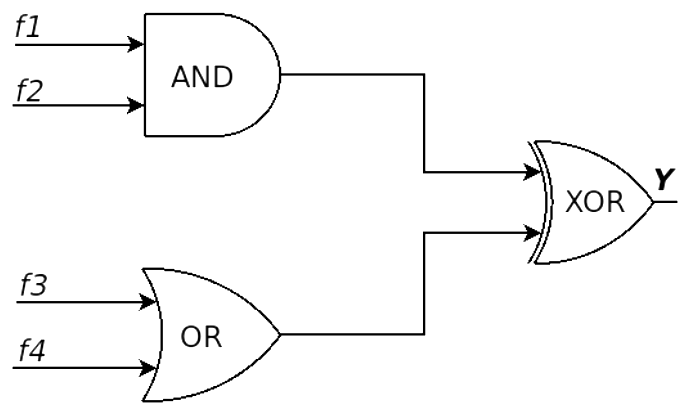
With respect to the circuit given above, which of the following options is/are CORRECT?
Answer
(C), (D)
Explanation
Work with minterm sets: AND keeps the minterms common to both inputs, OR takes their union, and XOR keeps the minterms that appear in exactly one input.
- \(f1 \cdot f2\): common minterms \(\{3, 5, 7, 11, 13\}\).
- \(f3 + f4\): \(\{0, 1, 2, 4, 6, 11, 13\}\).
- XOR: 11 and 13 are in both sets and cancel, leaving \(\{0, 1, 2, 3, 4, 5, 6, 7\}\).
So \(Y = \sum(0,1,2,3,4,5,6,7)\), which is (C). Its maxterms are the remaining minterms 8 to 15, so (D) is the same function. Options (A) and (B) both describe \(\sum(0,1,2,11,13)\), which is not \(Y\).
Answer: C, D