Consider a digital logic circuit consisting of three 2-to-1 multiplexers M1, M2, and M3 as shown below. X1 and X2 are inputs of M1. X3 and X4 are inputs of M2. A, B, and C are select lines of M1, M2, and M3, respectively.
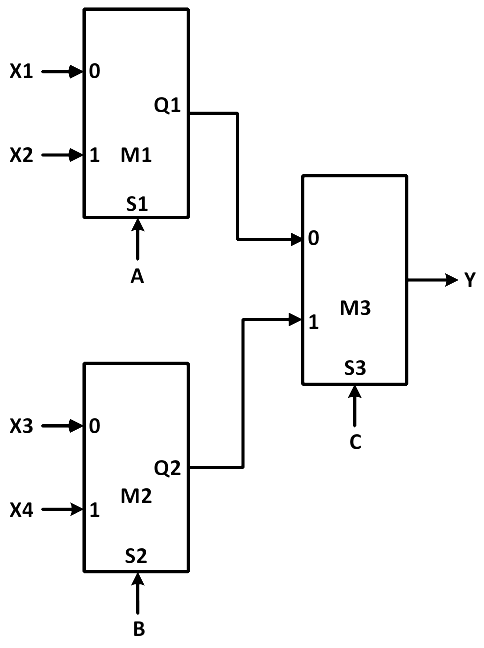
For an instance of inputs X1=1, X2=1, X3=0, and X4=0, the number of combinations of A, B, C that give the output Y=1 is _________
Answer
4
Explanation
A 2-to-1 multiplexer passes its input 0 when the select line is 0 and its input 1 when the select line is 1.
- M1 chooses between X1 = 1 and X2 = 1, so Q1 = 1 whatever A is.
- M2 chooses between X3 = 0 and X4 = 0, so Q2 = 0 whatever B is.
- M3 passes Q1 when C = 0 and Q2 when C = 1, so \(Y = \overline{C}\).
Y = 1 exactly when C = 0, while A and B can take any values: \(2 \times 2 = 4\) of the 8 combinations.
Answer: 4