GATE CS 2024 Set 1

65 questions · Previous year paper

The GATE 2024 Computer Science and Information Technology paper, Set 1: 65 questions for 100 marks in 180 minutes, with General Aptitude (15 marks) and the technical section (85 marks). Answers follow the official final answer key; every question has a short explanation.

Take it as a timed test: ₹99

General Aptitude

Question 1

MCQ · 1 mark · −0.33

If ‘→’ denotes increasing order of intensity, then the meaning of the words [dry → arid → parched] is analogous to [diet → fast → ________ ].

Which one of the given options is appropriate to fill the blank?

Options for Question 1

Explanation

Answer: (A)

In the first group, each word is a stronger degree of the same idea: dry, then arid (very dry), then parched (extremely dry, as if scorched).

The second group is about eating less. A diet limits food, a fast gives up food for a while, and the next, stronger step is to starve: to go without food until one suffers from it.

Reject and deny are not degrees of going without food, and feast is the opposite idea.

Answer: A
Question 2

MCQ · 1 mark · −0.33

If two distinct non-zero real variables \(x\) and \(y\) are such that \((x + y)\) is proportional to \((x - y)\) then the value of \(\frac{x}{y}\)

Options for Question 2

Explanation

Answer: (D)

“Proportional” means \(x + y = k(x - y)\) for some fixed constant \(k\). Rearranging,

\[x + y = kx - ky \;\Rightarrow\; y(k + 1) = x(k - 1) \;\Rightarrow\; \frac{x}{y} = \frac{k + 1}{k - 1}.\]

The right-hand side involves only the constant \(k\), so \(\frac{x}{y}\) is the same for every pair that satisfies the condition: it is a constant. (Here \(k \neq \pm 1\), because \(k = 1\) would force \(y = 0\) and \(k = -1\) would force \(x = 0\).)

Answer: D

Question 3

MCQ · 1 mark · −0.33

Consider the following sample of numbers:

9, 18, 11, 14, 15, 17, 10, 69, 11, 13

The median of the sample is

Options for Question 3

Explanation

Answer: (A)

The median is the middle value once the data are sorted:

9, 10, 11, 11, 13, 14, 15, 17, 18, 69

There are ten values, an even count, so the median is the average of the 5th and 6th values: \(\frac{13 + 14}{2} = 13.5\).

The large value 69 drags the mean up to \(\frac{187}{10} = 18.7\) (option D), but the median depends only on the order of the values, so the outlier does not move it. Option C, 11, is the mode.

Answer: A

Question 4

MCQ · 1 mark · −0.33

The number of coins of ₹1, ₹5, and ₹10 denominations that a person has are in the ratio 5:3:13. Of the total amount, the percentage of money in ₹5 coins is

Options for Question 4

Explanation

Answer: (C)

Take the coin counts as 5, 3 and 13; multiplying all three by the same factor would not change the percentage. The money held in each kind of coin is:

  • ₹1 coins: 5 × ₹1 = ₹5
  • ₹5 coins: 3 × ₹5 = ₹15
  • ₹10 coins: 13 × ₹10 = ₹130

The total is ₹150, so the share in ₹5 coins is \(\frac{15}{150} \times 100 = 10\%\).

Option B, \(14\frac{2}{7}\%\), is the share of ₹5 coins by count (3 out of 21 coins), not by value.

Answer: C

Question 5

MCQ · 1 mark · −0.33

For positive non-zero real variables \(p\) and \(q\), if

\[\log\,(p^{2} + q^{2}) = \log p + \log q + 2\log 3,\]

then, the value of \(\frac{p^{4}+q^{4}}{p^{2}q^{2}}\) is

Options for Question 5

Explanation

Answer: (A)

Combine the right-hand side into one logarithm: \(\log p + \log q + 2\log 3 = \log(9pq)\). Since the logarithm is one-to-one, the two arguments must be equal:

\[p^{2} + q^{2} = 9pq.\]

Now use \(p^{4} + q^{4} = (p^{2} + q^{2})^{2} - 2p^{2}q^{2}\). Squaring the relation gives \((p^{2} + q^{2})^{2} = 81p^{2}q^{2}\), so \(p^{4} + q^{4} = 79p^{2}q^{2}\) and

\[\frac{p^{4} + q^{4}}{p^{2}q^{2}} = 79.\]

Option B, 81, comes from forgetting to subtract the cross term \(2p^{2}q^{2}\).

Answer: A

Question 6

MCQ · 2 marks · −0.66

In the given text, the blanks are numbered (i)−(iv). Select the best match for all the blanks.

Steve was advised to keep his head ____(i)____ before heading ____(ii)____ to bat; for, while he had a head ____(iii)____ batting, he could only do so with a cool head ____(iv)____ his shoulders.

Options for Question 6

Explanation

Answer: (C)

Each blank completes a fixed English expression:

  • (i) to keep one’s head down is to stay focused and avoid distractions, so down.
  • (ii) a batter goes to the crease by heading out to bat, so out.
  • (iii) to have a head for something is to have a natural talent for it, so a head for batting.
  • (iv) a cool head on one’s shoulders means calm good sense, so on.

Only option C gives down, out, for, on. The other options use phrases such as “a head on batting” or “a cool head for his shoulders”, which are not idiomatic.

Answer: C

Question 7

MCQ · 2 marks · −0.66

A rectangular paper sheet of dimensions 54 cm × 4 cm is taken. The two longer edges of the sheet are joined together to create a cylindrical tube. A cube whose surface area is equal to the area of the sheet is also taken.

Then, the ratio of the volume of the cylindrical tube to the volume of the cube is

Options for Question 7

Explanation

Answer: (A)

Joining the two 54 cm edges makes a tube 54 cm long whose circular end has a circumference of 4 cm, so its radius is \(r = \frac{4}{2\pi} = \frac{2}{\pi}\) cm and

\[V_{\text{tube}} = \pi r^{2}h = \pi \cdot \frac{4}{\pi^{2}} \cdot 54 = \frac{216}{\pi}\ \text{cm}^{3}.\]

The sheet’s area is \(54 \times 4 = 216\ \text{cm}^{2}\). A cube with surface area \(6a^{2} = 216\) has side \(a = 6\) cm and volume \(216\ \text{cm}^{3}\).

The ratio is \(\dfrac{216/\pi}{216} = \dfrac{1}{\pi}\).

Answer: A

Question 8

MCQ · 2 marks · −0.66

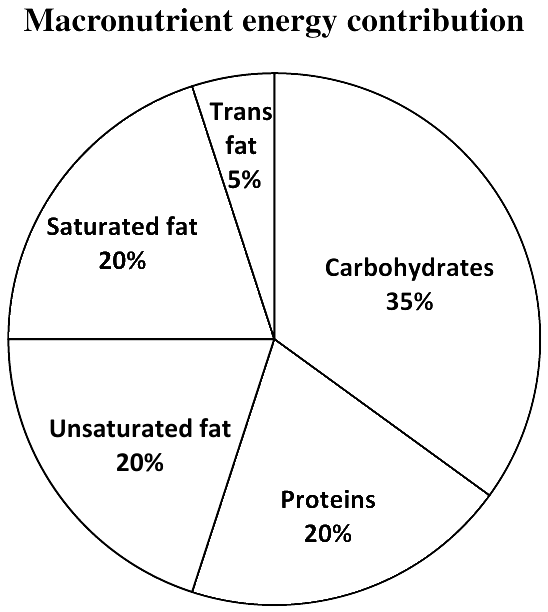
The pie chart presents the percentage contribution of different macronutrients to a typical 2,000 kcal diet of a person.

Pie chart titled “Macronutrient energy contribution” with five slices: Carbohydrates 35%, Proteins 20%, Unsaturated fat 20%, Saturated fat 20% and Trans fat 5%.

The typical energy density (kcal/g) of these macronutrients is given in the table.

MacronutrientEnergy density (kcal/g)
Carbohydrates4
Proteins4
Unsaturated fat9
Saturated fat9
Trans fat9

The total fat (all three types), in grams, this person consumes is

Options for Question 8

Explanation

Answer: (C)

The three kinds of fat together supply \(5\% + 20\% + 20\% = 45\%\) of the energy in the diet:

\[0.45 \times 2000 = 900\ \text{kcal}.\]

All three fats give 9 kcal per gram, so the person eats \(\frac{900}{9} = 100\) g of fat.

Option A, 44.4 g, counts only one of the 20% fat types (\(400 \div 9\)). Carbohydrates and proteins, at 4 kcal/g, play no part in the fat total.

Answer: C

Question 9

MCQ · 2 marks · −0.66

A rectangular paper of 20 cm × 8 cm is folded 3 times. Each fold is made along the line of symmetry, which is perpendicular to its long edge. The perimeter of the final folded sheet (in cm) is

Options for Question 9

Explanation

Answer: (A)

Each fold halves the sheet’s current long side, because the fold line is perpendicular to the long edge of the sheet as it is at that moment:

  • Fold 1: 20 × 8 becomes 10 × 8.
  • Fold 2: the long edge is now 10 cm, so 10 × 8 becomes 5 × 8.
  • Fold 3: the long edge is now 8 cm, so 5 × 8 becomes 5 × 4.

The final 5 cm × 4 cm sheet has perimeter \(2(5 + 4) = 18\) cm. Halving the 20 cm side all three times would give 2.5 × 8 and a perimeter of 21 cm (option D), but by the third fold that side is no longer the long edge.

Answer: A

Question 10

MCQ · 2 marks · −0.66

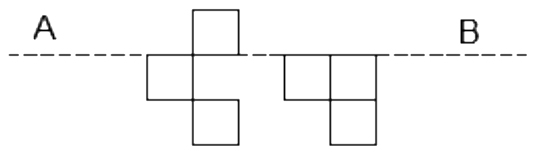
The least number of squares to be added in the figure to make AB a line of symmetry is

A horizontal dashed line runs from A on the left to B on the right. Left group: one square sits on top of the line, one square hangs just below the line to its lower left, and one square sits two rows below the line directly under the top square, with the cell directly under the top square left empty; right group: three squares hang below the line in an L shape, two side by side touching the line and one beneath the right-hand square.
Options for Question 10

Explanation

Answer: (A)

For AB to be a line of symmetry, every square needs a mirror image on the other side of AB, at the same distance from the line.

  • Left group: the square above the line needs its image in the empty cell directly below it; the square just below the line on the left needs an image just above the line; the square two rows down needs an image two rows up. That is 3 squares.
  • Right group: all three squares lie below the line, so each needs an image above it: 3 more squares.

None of these six cells is already filled, so the least number is \(3 + 3 = 6\).

Answer: A

Questions 1 to 10 of 65