Finite Automata

GATE CS previous year questions · 5 questions

GATE CS 2025 Set 1 | Question 28

MSQ · 1 mark

A regular language \(L\) is accepted by a non-deterministic finite automaton (NFA) with \(n\) states. Which of the following statement(s) is/are FALSE?

Options for GATE CS 2025 Set 1 | Question 28

Explanation

Answer: (D)

The question asks for the FALSE statements.

  • (A) True statement: a smaller NFA can exist. For example, if the given NFA (with \(n \ge 2\)) accepts every string, a 1-state NFA also accepts \(L\).
  • (B) True statement: in the same example a 1-state DFA accepts \(L\), so a DFA with fewer than \(n\) states is possible.
  • (C) True statement: the subset construction turns any \(n\)-state NFA into an equivalent DFA with at most \(2^{n}\) states.
  • (D) False: by (C), some DFA for \(L\) has at most \(2^{n}\) states, so not every DFA can have more than \(2^{n}\).

Answer: D
GATE CS 2025 Set 1 | Question 50

MSQ · 2 marks

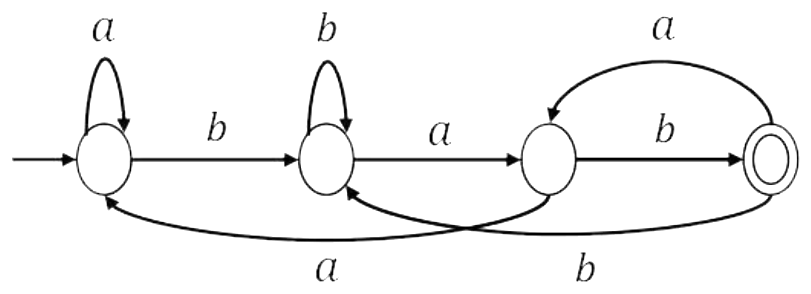
Consider the following deterministic finite automaton (DFA) defined over the alphabet, \(\Sigma = \{a, b\}\). Identify which of the following language(s) is/are accepted by the given DFA.

DFA with four states in a row over a and b; the leftmost is the start state and the rightmost is the only accepting state
Options for GATE CS 2025 Set 1 | Question 50

Explanation

Answer: (C)

Label the states \(q_0\) (start), \(q_1\), \(q_2\), \(q_3\) (accepting) from left to right. \(q_0\) loops on \(a\) and goes to \(q_1\) on \(b\); \(q_1\) loops on \(b\) and goes to \(q_2\) on \(a\); \(q_2\) goes to \(q_3\) on \(b\) and back to \(q_0\) on \(a\); \(q_3\) goes to \(q_2\) on \(a\) and to \(q_1\) on \(b\).

So \(q_1\), \(q_2\) and \(q_3\) mean that the input read so far ends with \(b\), \(ba\) and \(bab\). The DFA accepts exactly the strings ending with \(bab\), so (C) is correct.

  • (A) is wrong: \(bb\) has an even number of \(b\)'s but is rejected, while \(babab\) has three and is accepted.
  • (B) is wrong: \(baba\) contains \(bab\) but ends in \(q_2\).
  • (D) is wrong: \(b\) does not contain \(aba\) but is rejected.

Answer: C

GATE CS 2025 Set 1 | Question 59

NAT · 2 marks

Consider a finite state machine (FSM) with one input \(X\) and one output \(f\), represented by the given state transition table. The minimum number of states required to realize this FSM is ________. (Answer in integer)

Present stateNext stateOutput \(f\)
\(X = 0\)\(X = 1\)\(X = 0\)\(X = 1\)
AFB00
BDC00
CFE00
DGA10
EDC00
FFB11
GGH01
HGA10

Explanation

Answer: 5

Minimise by partition refinement. The output depends on the input (a Mealy machine), so first group the states by their output pair for \(X = 0\) and \(X = 1\).

  • By outputs: {A, B, C, E} have (0, 0), {D, H} have (1, 0), {F} has (1, 1) and {G} has (0, 1).
  • On \(X = 0\), A and C go to F but B and E go to D, and F, D are in different groups. So {A, B, C, E} splits into {A, C} and {B, E}. D and H have identical rows (G, A), so they stay together.
  • Next pass: A goes to (F, B) and C to (F, E), with B and E now in one group; B, E and D, H still have identical rows. Nothing splits further.

The groups {A, C}, {B, E}, {D, H}, {F}, {G} give 5 states.

Answer: 5

GATE CS 2025 Set 2 | Question 60

NAT · 2 marks

Let \(\Sigma = \{1,2,3,4\}\). For \(x \in \Sigma^{*}\), let \(\mathit{prod}(x)\) be the product of symbols in \(x\) modulo 7. We take \(\mathit{prod}(\epsilon) = 1\), where \(\epsilon\) is the null string.

For example, \(\mathit{prod}(124) = (1 \times 2 \times 4) \bmod 7 = 1\).

Define \(L = \{x \in \Sigma^{*} \mid \mathit{prod}(x) = 2\}\).

The number of states in a minimum state DFA for \(L\) is ___________. (Answer in integer)

Explanation

Answer: 6

A DFA only needs the product read so far as a residue mod 7, with residue 2 accepting. No symbol is a multiple of 7 and 7 is prime, so the product never becomes 0 and no dead state is needed. All six non-zero residues are reachable from the start state 1: 1, 2, 3, 4 directly, \(3 \times 4 \equiv 5\) and \(2 \times 3 = 6\).

The six states are pairwise distinguishable. For residues \(r \ne s\), take a string \(y\) with \(\mathit{prod}(y) \equiv 2r^{-1} \pmod{7}\) (one exists, since every non-zero residue is reachable). It takes \(r\) to 2 and accepts, but takes \(s\) to \(2sr^{-1} \not\equiv 2\) and rejects.

So the minimum DFA has 6 states.

Answer: 6

GATE CS 2024 Set 1 | Question 50

MSQ · 2 marks

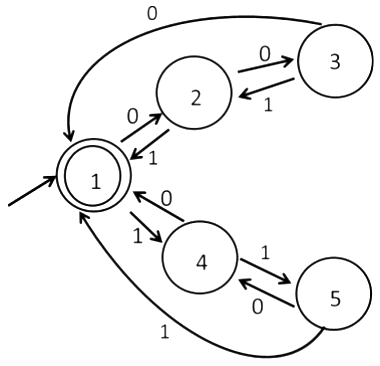
Consider the 5-state DFA \(M\) accepting the language \(L(M) \subset (0 + 1)^{*}\) shown below. For any string \(w \in (0 + 1)^{*}\) let \(n_{0}(w)\) be the number of \(0's\) in \(w\) and \(n_{1}(w)\) be the number of \(1's\) in \(w\).

A five-state DFA with states 1 to 5, where state 1 is both the start state and the only accepting state. On inputs 0 and 1 respectively, state 1 goes to 2 and 4, state 2 to 3 and 1, state 3 to 1 and 2, state 4 to 1 and 5, and state 5 to 4 and 1.

Which of the following statements is/are FALSE?

Options for GATE CS 2024 Set 1 | Question 50

Explanation

Answer: (B), (C)

Each state records \(n_{0} - n_{1} \bmod 3\) for the input read so far: a 0 adds 1 and a 1 subtracts 1. State 1 is residue 0, states 2 and 5 are residue 1, and states 3 and 4 are residue 2; every arrow fits (for example, 3 goes to 2 on a 1, and 5 goes to 4 on a 0). So \(L(M)\) is the set of strings with \(n_{0}(w) - n_{1}(w) \equiv 0 \pmod{3}\).

  • (A) is true: the input 1 takes state 2 to the accepting state 1 but takes state 4 to state 5.
  • (B) and (C) are false: 3 and 4 have the same residue, as do 2 and 5, so every suffix leads both states of a pair to the same verdict. They are equivalent, not distinguishable.
  • (D) is true: equal counts give a difference of 0.

Answer: B, C