Theory of Computation

GATE CS previous year questions · 20 questions

Topics

GATE CS 2025 Set 1 | Question 19

MCQ · 1 mark · −0.33

Consider the following context-free grammar \(G\), where \(S\), \(A\), and \(B\) are the variables (non-terminals), \(a\) and \(b\) are the terminal symbols, \(S\) is the start variable, and the rules of \(G\) are described as:

\(S \to aaB \mid Abb\)
\(A \to a \mid aA\)
\(B \to b \mid bB\)

Which ONE of the languages \(L(G)\) is accepted by \(G\)?

Options for GATE CS 2025 Set 1 | Question 19

Explanation

Answer: (A)

\(A \to a \mid aA\) generates \(a^{n}\) and \(B \to b \mid bB\) generates \(b^{n}\), for \(n \ge 1\).

So \(S \to aaB\) gives the strings \(a^{2}b^{n}\), and \(S \to Abb\) gives the strings \(a^{n}b^{2}\). Together, \(L(G) = \{a^{2}b^{n} \mid n \ge 1\} \cup \{a^{n}b^{2} \mid n \ge 1\}\).

The other options do not match: for example, \(aabbb \in L(G)\), but it belongs to none of (B), (C) and (D).

Answer: A
GATE CS 2025 Set 1 | Question 28

MSQ · 1 mark

A regular language \(L\) is accepted by a non-deterministic finite automaton (NFA) with \(n\) states. Which of the following statement(s) is/are FALSE?

Options for GATE CS 2025 Set 1 | Question 28

Explanation

Answer: (D)

The question asks for the FALSE statements.

  • (A) True statement: a smaller NFA can exist. For example, if the given NFA (with \(n \ge 2\)) accepts every string, a 1-state NFA also accepts \(L\).
  • (B) True statement: in the same example a 1-state DFA accepts \(L\), so a DFA with fewer than \(n\) states is possible.
  • (C) True statement: the subset construction turns any \(n\)-state NFA into an equivalent DFA with at most \(2^{n}\) states.
  • (D) False: by (C), some DFA for \(L\) has at most \(2^{n}\) states, so not every DFA can have more than \(2^{n}\).

Answer: D

GATE CS 2025 Set 1 | Question 30

NAT · 1 mark

Let \(S\) be the set of all ternary strings defined over the alphabet \(\{a, b, c\}\). Consider all strings in \(S\) that contain at least one occurrence of two consecutive symbols, that is, “aa”, “bb” or “cc”. The number of such strings of length 5 that are possible is _______. (Answer in integer)

Explanation

Answer: 195

Count the complement first: length-5 strings in which no two neighbouring symbols are the same. The first symbol has 3 choices and each of the next four has 2 (anything except the symbol just before it), so there are \(3 \times 2^{4} = 48\) such strings.

There are \(3^{5} = 243\) strings in all, so the number with at least one “aa”, “bb” or “cc” is \(243 - 48 = 195\).

Answer: 195

GATE CS 2025 Set 1 | Question 44

MCQ · 2 marks · −0.66

Consider the following two languages over the alphabet \(\{a, b\}\):

\[ L_1 = \{\, \alpha\beta\alpha \mid \alpha \in \{a, b\}^+ \text{ AND } \beta \in \{a, b\}^+ \,\} \]

\[ L_2 = \{\, \alpha\beta\alpha \mid \alpha \in \{a\}^+ \text{ AND } \beta \in \{a, b\}^+ \,\} \]

Which ONE of the following statements is CORRECT?

Options for GATE CS 2025 Set 1 | Question 44

Explanation

Answer: (C)

  • \(L_2\): \(\alpha\) is a block of a's, so any \(a^k \beta a^k\) can be rewritten with \(\alpha = a\) by moving the extra a's into the middle part. So \(L_2 = {a(a+b)^+a}\), the strings of length at least 3 that start and end with \(a\), which is regular.
  • \(L_1\): shrinking \(\alpha\) to one symbol fails, because \(\alpha\) may start and end with different symbols; for example \(abaab = (ab)(a)(ab) \in L_1\). A finite automaton would have to remember an arbitrarily long \(\alpha\).
  • Pumping lemma proof for \(L_1\): \(w = a^n b\, a\, a^n b \in L_1\) (\(\alpha = a^n b\), \(\beta = a\)). Pumping up the leading a's gives \(a^{n+k} b\, a^{n+1} b\). Here \(\alpha\) must be a prefix ending in \(b\), i.e. \(a^{n+k} b\), and that is a suffix only when \(k = 1\), when nothing is left for \(\beta\). So the pumped string is not in \(L_1\), and \(L_1\) is not regular.

Answer: C

GATE CS 2025 Set 1 | Question 45

MCQ · 2 marks · −0.66

Consider the following two languages over the alphabet \(\{a, b, c\}\), where \(m\) and \(n\) are natural numbers.

\[ L_1 = \{a^m b^m c^{m+n} \mid m, n \ge 1\} \]

\[ L_2 = \{a^m b^n c^{m+n} \mid m, n \ge 1\} \]

Which ONE of the following statements is CORRECT?

Options for GATE CS 2025 Set 1 | Question 45

Explanation

Answer: (C)

  • \(L_2\) is context-free: \(a^m b^n c^{m+n} = a^m\,(b^n c^n)\,c^m\) is a nested pattern, generated by \(S \to aSc \mid aAc\), \(A \to bAc \mid bc\). A PDA pushes one symbol for every \(a\) and \(b\) and pops one for every \(c\).
  • \(L_1\) is not context-free: it needs \(\#a = \#b\) and also \(\#c \gt \#a\) (because \(n \ge 1\)), so the same count \(m\) must be compared twice, but the single stack is used up matching the a's against the b's.
  • Pumping lemma check: take \(a^p b^p c^{p+1}\). The pumped part (length \(\le p\)) cannot touch both a's and c's. If it contains a's or b's, pumping up gives \(\#a \ne \#b\) or \(\#a = \#b \ge p + 1 = \#c\); if it contains only c's, pumping down gives \(\#c \le p = \#a\). Either way the string leaves \(L_1\).

Answer: C

GATE CS 2025 Set 1 | Question 50

MSQ · 2 marks

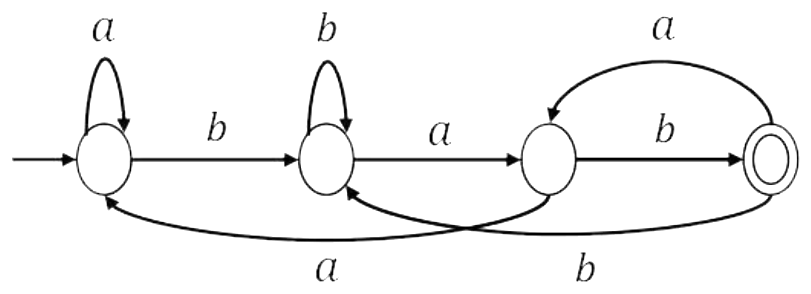
Consider the following deterministic finite automaton (DFA) defined over the alphabet, \(\Sigma = \{a, b\}\). Identify which of the following language(s) is/are accepted by the given DFA.

DFA with four states in a row over a and b; the leftmost is the start state and the rightmost is the only accepting state
Options for GATE CS 2025 Set 1 | Question 50

Explanation

Answer: (C)

Label the states \(q_0\) (start), \(q_1\), \(q_2\), \(q_3\) (accepting) from left to right. \(q_0\) loops on \(a\) and goes to \(q_1\) on \(b\); \(q_1\) loops on \(b\) and goes to \(q_2\) on \(a\); \(q_2\) goes to \(q_3\) on \(b\) and back to \(q_0\) on \(a\); \(q_3\) goes to \(q_2\) on \(a\) and to \(q_1\) on \(b\).

So \(q_1\), \(q_2\) and \(q_3\) mean that the input read so far ends with \(b\), \(ba\) and \(bab\). The DFA accepts exactly the strings ending with \(bab\), so (C) is correct.

  • (A) is wrong: \(bb\) has an even number of \(b\)'s but is rejected, while \(babab\) has three and is accepted.
  • (B) is wrong: \(baba\) contains \(bab\) but ends in \(q_2\).
  • (D) is wrong: \(b\) does not contain \(aba\) but is rejected.

Answer: C

GATE CS 2025 Set 1 | Question 59

NAT · 2 marks

Consider a finite state machine (FSM) with one input \(X\) and one output \(f\), represented by the given state transition table. The minimum number of states required to realize this FSM is ________. (Answer in integer)

Present stateNext stateOutput \(f\)
\(X = 0\)\(X = 1\)\(X = 0\)\(X = 1\)
AFB00
BDC00
CFE00
DGA10
EDC00
FFB11
GGH01
HGA10

Explanation

Answer: 5

Minimise by partition refinement. The output depends on the input (a Mealy machine), so first group the states by their output pair for \(X = 0\) and \(X = 1\).

  • By outputs: {A, B, C, E} have (0, 0), {D, H} have (1, 0), {F} has (1, 1) and {G} has (0, 1).
  • On \(X = 0\), A and C go to F but B and E go to D, and F, D are in different groups. So {A, B, C, E} splits into {A, C} and {B, E}. D and H have identical rows (G, A), so they stay together.
  • Next pass: A goes to (F, B) and C to (F, E), with B and E now in one group; B, E and D, H still have identical rows. Nothing splits further.

The groups {A, C}, {B, E}, {D, H}, {F}, {G} give 5 states.

Answer: 5

GATE CS 2025 Set 2 | Question 24

MCQ · 1 mark · −0.33

Which ONE of the following languages is accepted by a deterministic pushdown automaton?

Options for GATE CS 2025 Set 2 | Question 24

Explanation

Answer: (A)

A DFA is simply a DPDA that never touches its stack, so every regular language is accepted by some DPDA. That makes (A) true.

  • (B) and (C) describe the same class, because non-deterministic PDAs accept exactly the context-free languages. Both fail because DPDAs are strictly weaker: the even-length palindromes \(\{ww^{R} \mid w \in \{a, b\}^{*}\}\) are context-free, but no DPDA can tell where the middle of the input is.
  • (D) fails because a decidable language such as \(\{a^{n}b^{n}c^{n} \mid n \ge 0\}\) is not even context-free, so no pushdown automaton of either kind accepts it.

Answer: A

GATE CS 2025 Set 2 | Question 25

MCQ · 1 mark · −0.33

Let \(G_{1}, G_{2}\) be Context Free Grammars (CFGs) and \(R\) be a regular expression. For a grammar \(G\), let \(L(G)\) denote the language generated by \(G\).

Which ONE among the following questions is decidable?

Options for GATE CS 2025 Set 2 | Question 25

Explanation

Answer: (D)

Emptiness of a CFG is decidable. Mark every variable that can derive a string of terminals: first those with a production whose body has only terminals (or is \(\varepsilon\)), then, repeatedly, any variable with a body made of terminals and marked variables. \(L(G_{1}) = \emptyset\) exactly when the start symbol is never marked, and the marking stops after at most as many rounds as there are variables. So (D) is decidable.

The other three are undecidable for CFGs:

  • (A) equivalence of two CFGs;
  • (B) whether two context-free languages share a string;
  • (C) with \(R = \Sigma^{*}\), it asks whether \(G_{1}\) generates every string, which is undecidable.

Answer: D

GATE CS 2025 Set 2 | Question 30

MSQ · 1 mark

Consider the two lists List I and List II given below:

List IList II
(i) Context free languages(a) Closed under union
(ii) Recursive languages(b) Not closed under complementation
(iii) Regular languages(c) Closed under intersection

For matching of items in List I with those in List II, which of the following option(s) is/are CORRECT?

Options for GATE CS 2025 Set 2 | Question 30

Explanation

Answer: (B), (C)

Test each class against each property:

  • Context-free languages are closed under union but not under intersection or complementation. For example, with \(m, n \ge 0\), \(\{a^{n}b^{n}c^{m}\}\) and \(\{a^{m}b^{n}c^{n}\}\) are context-free, but their intersection \(\{a^{n}b^{n}c^{n}\}\) is not. So (i) fits (a) and (b), not (c).
  • Recursive languages are closed under union, intersection and complementation (swap a decider's accept and reject answers). So (ii) fits (a) and (c), not (b).
  • Regular languages are closed under all three as well, so (iii) fits (a) and (c), not (b).

Option A fails on (ii) – (b) and option D on (iii) – (b), while every pair in B and C is true.

Answer: B, C