GATE DA 2025

65 questions · Previous year paper

The GATE 2025 Data Science and Artificial Intelligence paper: 65 questions for 100 marks in 180 minutes, with General Aptitude (15 marks) and the technical section (85 marks). Answers follow the official final answer key; every question has a short explanation.

Take it as a timed test: ₹49

Data Science and Artificial Intelligence

Question 51

MSQ · 2 marks

Let \(f : \mathbb{R} \to \mathbb{R}\) be a twice-differentiable function and suppose its second derivative satisfies \(f''(x) > 0\) for all \(x \in \mathbb{R}\). Which of the following statements is/are ALWAYS correct?

Options for Question 51

Explanation

Answer: (B), (C), (D)

Since \(f''(x) > 0\) everywhere, \(f'\) is strictly increasing, so it can be zero at most once; \(f\) is strictly convex.

  • A fails: \(f(x) = e^{x}\) has \(f''(x) = e^{x} > 0\), yet \(f'(x) = e^{x}\) is never 0, so this \(f\) has no minimum at all.
  • B holds: a strictly increasing \(f'\) cannot be 0 at two different points.
  • D holds: at a local minimum of a differentiable function \(f' = 0\), and there is at most one such point.
  • C holds: every global minimum is also a local minimum, so there is at most one.

Answer: B, C, D
Question 52

MSQ · 2 marks

An \(n \times n\) matrix \(A\) with real entries satisfies the property: \(\|Ax\|^{2} = \|x\|^{2}\), for all \(x \in \mathbb{R}^{n}\), where \(\| \cdot \|\) denotes the Euclidean norm. Which of the following statements is/are ALWAYS correct?

Options for Question 52

Explanation

Answer: (A), (D)

Write the condition as \(x^{\top}(A^{\top}A - I)x = 0\) for every \(x\). The matrix \(A^{\top}A - I\) is symmetric, and a symmetric matrix whose quadratic form is zero for every \(x\) is the zero matrix. So \(A^{\top}A = I\), and \(A\) is orthogonal: A holds.

  • D holds: \(A^{\top}A = I\) means \(A^{-1} = A^{\top}\) exists, so \(A\) has full rank.
  • B fails: \(-I\), or any rotation, also preserves lengths.
  • C fails: the rotation by 90\(^{\circ}\), \(\begin{pmatrix} 0 & -1 \\ 1 & 0 \end{pmatrix}\), is orthogonal, but its eigenvalues are \(\pm i\). An orthogonal matrix only guarantees eigenvalues of modulus 1.

Answer: A, D

Question 53

MSQ · 2 marks

Consider designing a linear binary classifier \(f(x) = \operatorname{sign}(w^{\top}x + b)\), \(x \in \mathbb{R}^{2}\) on the following training data:

\[ \text{Class-1: } \left\{ \begin{pmatrix} 2 \\ 0 \end{pmatrix}, \begin{pmatrix} 0 \\ 2 \end{pmatrix}, \begin{pmatrix} 2 \\ 2 \end{pmatrix} \right\}, \ \text{Class-2: } \left\{ \begin{pmatrix} 0 \\ 0 \end{pmatrix} \right\} \]

Hard-margin support vector machine (SVM) formulation is solved to obtain \(w\) and \(b\). Which of the following options is/are correct?

Options for Question 53

Explanation

Answer: (B), (C)

The triangle formed by the Class-1 points comes closest to the origin at \((1, 1)\), the midpoint of its edge from \((2, 0)\) to \((0, 2)\). The maximum-margin boundary is the perpendicular bisector of the segment from \((0, 0)\) to \((1, 1)\), the line \(x_{1} + x_{2} = 1\). In canonical form (Class-1 as \(+1\)), \(w = (1, 1)^{\top}\) and \(b = -1\): \(w^{\top}x + b\) is 1 at \((2, 0)\) and \((0, 2)\), \(-1\) at \((0, 0)\) and 3 at \((2, 2)\).

  • A fails: \(w = (4, 4)^{\top}\), \(b = 1\) gives every point, \((0, 0)\) included, a positive score, so it does not separate the classes.
  • B holds: \((2, 0)\), \((0, 2)\) and \((0, 0)\) lie on the margin lines; \((2, 2)\) lies beyond them.
  • C holds: the margin lines \(x_{1} + x_{2} = 0\) and \(x_{1} + x_{2} = 2\) are \(\frac{2}{\|w\|} = \sqrt{2}\) apart.
  • D fails: the data are separable, so training accuracy is 100%.

Answer: B, C

Question 54

MSQ · 2 marks

Consider a coin-toss experiment where the probability of head showing up is \(p\). In the \(i^{\text{th}}\) coin toss, let \(X_{i} = 1\) if head appears, and \(X_{i} = 0\) if tail appears. Consider

\[ \widehat{p} = \frac{1}{n}\sum_{i=1}^{n} X_{i} \]

where \(n\) is the total number of independent coin tosses.

Which of the following statements is/are correct?

Options for Question 54

Explanation

Answer: (A), (C)

Each \(X_{i}\) is a Bernoulli variable with \(E[X_{i}] = p\) and \(\operatorname{Var}(X_{i}) = p(1 - p)\).

  • By linearity of expectation, \(E[\,\widehat{p}\,] = \frac{1}{n} \cdot np = p\). So A holds and B fails; \(\frac{p}{n}\) forgets that the sum has \(n\) terms.
  • The tosses are independent, so the variances add: \(\operatorname{Var}(\widehat{p}) = \frac{1}{n^{2}} \cdot np(1 - p) = \frac{p(1 - p)}{n}\). This shrinks as \(n\) grows, so C holds and D fails.

In short, \(\widehat{p}\) is an unbiased estimator of \(p\) that gets more precise with more tosses.

Answer: A, C

Question 55

MSQ · 2 marks

Consider a two-class problem in \(\mathbb{R}^{d}\) with class labels red and green. Let \(\mu_{\textit{red}}\) and \(\mu_{\textit{green}}\) be the means of the two classes. Given test sample \(x \in \mathbb{R}^{d}\), a classifier calculates the squared Euclidean distance (denoted by \(\| \cdot \|^{2}\)) between \(x\) and the means of the two classes and assigns the class label that the sample \(x\) is closest to. That is, the classifier computes

\[ f(x) = \|\mu_{\textit{red}} - x\|^{2} - \|\mu_{\textit{green}} - x\|^{2} \]

and assigns the label red to \(x\) if \(f(x) < 0\), and green otherwise. Which of the following statements is/are correct?

Options for Question 55

Explanation

Answer: (B), (C)

Expand each squared distance as \(\|\mu - x\|^{2} = \|\mu\|^{2} - 2\mu^{\top}x + \|x\|^{2}\). The \(\|x\|^{2}\) terms cancel in the difference:

\[ f(x) = 2(\mu_{\textit{green}} - \mu_{\textit{red}})^{\top}x + \|\mu_{\textit{red}}\|^{2} - \|\mu_{\textit{green}}\|^{2} \]

  • B and C hold: \(f(x) = w^{\top}x + b\) with \(w = 2(\mu_{\textit{green}} - \mu_{\textit{red}})\) and \(b = \|\mu_{\textit{red}}\|^{2} - \|\mu_{\textit{green}}\|^{2}\), so the decision boundary is a hyperplane.
  • D fails: the quadratic term cancels.
  • A fails: \(f(0) = \|\mu_{\textit{red}}\|^{2} - \|\mu_{\textit{green}}\|^{2} < 0\) when \(\|\mu_{\textit{red}}\| < \|\mu_{\textit{green}}\|\), so the origin gets the label red, the nearer mean.

Answer: B, C

Question 56

MSQ · 2 marks

Consider the following two relations, named Customer and Person, in a database:

Person (
    aadhaar CHAR(12) PRIMARY KEY,
    name VARCHAR(32));
Customer (
    name VARCHAR(32),
    email VARCHAR(32) PRIMARY KEY,
    phone CHAR(10),
    aadhaar CHAR(12),
      FOREIGN KEY (aadhaar) REFERENCES Person(aadhaar));

Which of the following statements is/are correct?

Options for Question 56

Explanation

Answer: (B), (C)

Only the declared constraints restrict the columns.

  • A fails: the primary key of Customer is email, and aadhaar there is only a foreign key with no UNIQUE constraint. Several customer rows (say, one person with two email addresses) can share the same aadhaar, so it is not a candidate key.
  • B holds: phone has no NOT NULL or key constraint, so it may be NULL.
  • C holds: aadhaar is the primary key of Person, and a primary key is always a candidate key.
  • D fails: a primary key column can never be NULL.

Answer: B, C

Question 57

MSQ · 2 marks

Consider a database relation R with attributes ABCDEFG, and having the following functional dependencies:

\[ \mathrm{A} \rightarrow \mathrm{BCEF} \qquad \mathrm{E} \rightarrow \mathrm{DG} \qquad \mathrm{BC} \rightarrow \mathrm{A} \]

Which of the following statements is/are correct?

Options for Question 57

Explanation

Answer: (B), (D)

Find the keys with attribute closures.

  • \(\mathrm{A}^{+}\): A \(\rightarrow\) BCEF, then E \(\rightarrow\) DG, so \(\mathrm{A}^{+} = \mathrm{ABCDEFG}\) and A is a key.
  • \(\mathrm{BC}^{+}\): BC \(\rightarrow\) A, and everything follows as above. \(\mathrm{B}^{+} = \mathrm{B}\) and \(\mathrm{C}^{+} = \mathrm{C}\), so BC is a candidate key.
  • \(\mathrm{E}^{+} = \mathrm{DEG}\), so E is not a key.

A appears on a right side only in BC \(\rightarrow\) A, and B and C are determined only by A, so every key contains A or both B and C. The candidate keys are exactly A and BC: B holds, while A and C fail.

In E \(\rightarrow\) DG the left side E is not a superkey, so R is not in BCNF and D holds.

Answer: B, D

Question 58

MSQ · 2 marks

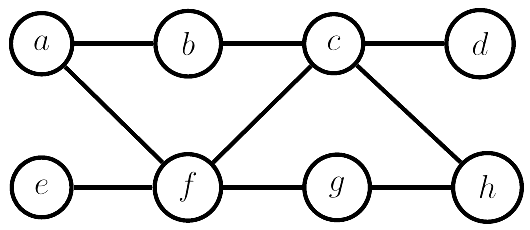
Let \(G\) be a simple, unweighted, and undirected graph. A subset of the vertices and edges of \(G\) are shown below.

Eight vertices in two rows, a, b, c, d on top and e, f, g, h below. Edges join a and b, b and c, c and d, e and f, f and g, g and h, and also a and f, f and c, and c and h.

It is given that \(a - b - c - d\) is a shortest path between \(a\) and \(d\); \(e - f - g - h\) is a shortest path between \(e\) and \(h\); \(a - f - c - h\) is a shortest path between \(a\) and \(h\). Which of the following is/are NOT the edges of \(G\)?

Options for Question 58

Explanation

Answer: (A), (C), (D)

Each given shortest path has 3 edges, so in \(G\) the distances between \(a\) and \(d\), \(e\) and \(h\), and \(a\) and \(h\) are all exactly 3. An edge that would create a path of length 2 between one of these pairs cannot be in \(G\).

  • \((b, d)\) would give \(a - b - d\), of length 2 between \(a\) and \(d\). Not an edge.
  • \((b, h)\) would give \(a - b - h\), of length 2 between \(a\) and \(h\). Not an edge.
  • \((e, g)\) would give \(e - g - h\), of length 2 between \(e\) and \(h\). Not an edge.
  • \((b, g)\) shortens none of the three distances (for example, \(a - b - g - h\) still has length 3), so it may be an edge of \(G\).

Answer: A, C, D

Question 59

NAT · 2 marks

Let \(f : \mathbb{R} \to \mathbb{R}\) be such that \(|f(x) - f(y)| \le (x - y)^{2}\) for all \(x, y \in \mathbb{R}\). Then \(f(1) - f(0) =\) ________ (Answer in integer)

Explanation

Answer: 0

For \(x \neq y\), divide the condition by \(|x - y|\):

\[ \left| \frac{f(x) - f(y)}{x - y} \right| \le |x - y| \]

As \(y \to x\) the right side tends to 0, so \(f\) is differentiable with \(f'(x) = 0\) for every \(x\). Hence \(f\) is constant and \(f(1) - f(0) = 0\).

Without derivatives: split \([0, 1]\) into \(n\) equal steps. Each step changes \(f\) by at most \(\frac{1}{n^{2}}\), so \(|f(1) - f(0)| \le n \cdot \frac{1}{n^{2}} = \frac{1}{n}\) for every \(n\), which forces the difference to be 0.

Answer: 0

Question 60

NAT · 2 marks

Let \(D = \{x^{(1)}, \ldots, x^{(n)}\}\) be a dataset of \(n\) observations where each \(x^{(i)} \in \mathbb{R}^{100}\). It is given that \(\sum_{i=1}^{n} x^{(i)} = 0\). The covariance matrix computed from \(D\) has eigenvalues \(\lambda_{i} = 100^{2-i}\), \(1 \le i \le 100\). Let \(u \in \mathbb{R}^{100}\) be the direction of maximum variance with \(u^{\top}u = 1\).

The value of

\[ \frac{1}{n}\sum_{i=1}^{n} \left(u^{\top}x^{(i)}\right)^{2} = \]

________ (Answer in integer)

Explanation

Answer: 100

Since \(\sum_{i} x^{(i)} = 0\), the data are already centred, so the covariance matrix is \(C = \frac{1}{n}\sum_{i=1}^{n} x^{(i)}x^{(i)\top}\). Then

\[ \frac{1}{n}\sum_{i=1}^{n} \left(u^{\top}x^{(i)}\right)^{2} = \frac{1}{n}\sum_{i=1}^{n} u^{\top}x^{(i)}x^{(i)\top}u = u^{\top}Cu, \]

the variance of the data along \(u\). Over unit vectors, \(u^{\top}Cu\) is largest for the top eigenvector of \(C\) (the first principal component), and that largest value is the top eigenvalue.

The eigenvalues \(100^{2-i}\) decrease with \(i\): \(100, 1, 0.01, \ldots\). So the value is \(\lambda_{1} = 100^{1} = 100\).

Answer: 100

Questions 51 to 60 of 65