Reasoning under Uncertainty

GATE DA previous year questions · 3 questions

GATE DA 2025 | Question 26

MSQ · 1 mark

Which of the following statements is/are correct in a Bayesian network?

Options for GATE DA 2025 | Question 26

Explanation

Answer: (C), (D)

  • Variable elimination is an exact method. It multiplies the relevant conditional probability tables and sums out the hidden variables one at a time, so A is false.
  • What it returns is a conditional probability such as \(P(Q \mid e)\) for a query \(Q\) given evidence \(e\), so C is true.
  • Gibbs sampling and rejection sampling both estimate probabilities from random samples. Their answers are approximate and improve as more samples are drawn, so B is false and D is true.

Answer: C, D
GATE DA 2024 | Question 24

MCQ · 1 mark · −0.33

Consider five random variables \(U, V, W, X\), and \(Y\) whose joint distribution satisfies:

\[P(U, V, W, X, Y) = P(U)P(V)P(W \mid U, V)P(X \mid W)P(Y \mid W)\]

Which ONE of the following statements is FALSE?

Options for GATE DA 2024 | Question 24

Explanation

Answer: (C)

The factorisation is the Bayesian network \(U \rightarrow W \leftarrow V\), \(W \rightarrow X\), \(W \rightarrow Y\).

  • A and B: \(U\) and \(V\) reach \(X\) and \(Y\) only through chains such as \(V \rightarrow W \rightarrow Y\), and observing \(W\) blocks a chain. Both are true.
  • D: \(X \leftarrow W \rightarrow Y\) has \(W\) as a common cause, so \(X\) and \(Y\) are independent once \(W\) is known. True.
  • C: \(U\) and \(V\) are independent on their own (the factor \(P(U)P(V)\)), but \(W\) is their common effect. Observing a common effect couples its causes (explaining away): once \(W\) is known, learning \(U\) changes what \(V\) is likely to be. So C does not hold in general.

Answer: C

GATE DA 2024 | Question 64

NAT · 2 marks

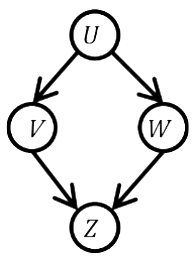
Given the following Bayesian Network consisting of four Bernoulli random variables and the associated conditional probability tables:

Bayesian network with four nodes: U has arrows to V and to W, and V and W each have an arrow to Z.
\(P(\cdot)\)
\(U = 0\)0.5
\(U = 1\)0.5
\(P(V = 0 | \cdot)\)\(P(V = 1 | \cdot)\)
\(U = 0\)0.50.5
\(U = 1\)0.50.5
\(P(W = 0 | \cdot)\)\(P(W = 1 | \cdot)\)
\(U = 0\)10
\(U = 1\)01
\(P(Z = 0 | \cdot)\)\(P(Z = 1 | \cdot)\)
\(V = 0\)\(W = 0\)0.50.5
\(V = 0\)\(W = 1\)10
\(V = 1\)\(W = 0\)10
\(V = 1\)\(W = 1\)0.50.5

The value of \(P(U = 1, V = 1, W = 1, Z = 1) =\) ______ (rounded off to three decimal places).

Explanation

Answer: 0.13

A Bayesian network factorises the joint probability into one factor per node, each conditioned on that node's parents. Here U has no parents, V and W each have parent U, and Z has parents V and W:

\[ P(U, V, W, Z) = P(U)\,P(V|U)\,P(W|U)\,P(Z|V, W) \]

Reading the tables for \(U = 1, V = 1, W = 1, Z = 1\):

  • \(P(U = 1) = 0.5\)
  • \(P(V = 1|U = 1) = 0.5\)
  • \(P(W = 1|U = 1) = 1\)
  • \(P(Z = 1|V = 1, W = 1) = 0.5\)

So the joint probability is \(0.5 \times 0.5 \times 1 \times 0.5 = 0.125\).

Answer: 0.125