Artificial Intelligence

GATE DA previous year questions · 11 questions

Topics

GATE DA 2025 | Question 15

MCQ · 1 mark · −0.33

Let \(p\) and \(q\) be any two propositions. Consider the following propositional statements.
\(S_{1} : p \to q\), \(S_{2} : \neg p \wedge q\), \(S_{3} : \neg p \vee q\), \(S_{4} : \neg p \vee \neg q\),
where \(\wedge\) denotes conjunction (AND operation), \(\vee\) denotes disjunction (OR operation), and \(\neg\) denotes negation (NOT operation). Which one of the following options is correct? (Note: \(\equiv\) denotes logical equivalence)

Options for GATE DA 2025 | Question 15

Explanation

Answer: (A)

\(p \to q\) is false only when \(p\) is true and \(q\) is false, and \(\neg p \vee q\) is false in exactly the same case, so \(S_{1} \equiv S_{3}\).

Every other pair differs on at least one row of the truth table:

  • \(S_{2}\) and \(S_{3}\): with \(p\) and \(q\) both true, \(S_{2}\) is false but \(S_{3}\) is true.
  • \(S_{2}\) and \(S_{4}\): with both false, \(S_{2}\) is false but \(S_{4}\) is true.
  • \(S_{1}\) and \(S_{4}\): with both true, \(S_{1}\) is true but \(S_{4}\) is false.

Answer: A
GATE DA 2025 | Question 26

MSQ · 1 mark

Which of the following statements is/are correct in a Bayesian network?

Options for GATE DA 2025 | Question 26

Explanation

Answer: (C), (D)

  • Variable elimination is an exact method. It multiplies the relevant conditional probability tables and sums out the hidden variables one at a time, so A is false.
  • What it returns is a conditional probability such as \(P(Q \mid e)\) for a query \(Q\) given evidence \(e\), so C is true.
  • Gibbs sampling and rejection sampling both estimate probabilities from random samples. Their answers are approximate and improve as more samples are drawn, so B is false and D is true.

Answer: C, D

GATE DA 2025 | Question 43

MCQ · 2 marks · −0.66

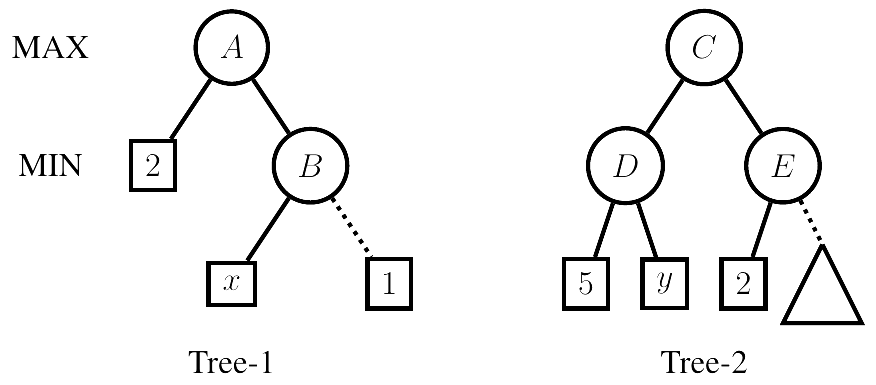
Consider game trees Tree-1 and Tree-2 as shown. The first level is a MAX agent and the second level is a MIN agent. The value in the square node is the output of the utility function.

Tree-1 (left): MAX root A has a square leaf 2 and a MIN child B, whose square leaves are x and 1, with the edge from B to 1 drawn dotted. Tree-2 (right): MAX root C has MIN children D (square leaves 5 and y) and E (a square leaf 2 and, by a dotted edge, a subtree drawn as a triangle).

For what ranges of \(x\) and \(y\), the right child of node \(B\) and the right child of node \(E\) will be pruned by alpha-beta pruning algorithm?

Options for GATE DA 2025 | Question 43

Explanation

Answer: (C)

Alpha-beta pruning skips the remaining children of a MIN node once its value \(\beta\) can no longer beat the value \(\alpha\) that MAX is already sure of, that is, once \(\beta \le \alpha\).

  • Tree-1: after the leaf 2, MAX at A has \(\alpha = 2\). At B, the leaf \(x\) gives \(\beta = x\). The leaf 1 is pruned when \(x \le 2\), because B is then worth at most 2 and cannot raise A above 2. So \(x \in (-\infty, 2]\).
  • Tree-2: D is searched fully, so \(\alpha = \min(5, y)\) at C. At E, the leaf 2 gives \(\beta = 2\), and the triangle is pruned when \(2 \le \min(5, y)\), i.e. \(y \ge 2\). So \(y \in [2, \infty)\).

Only option C has both ranges.

Answer: C

GATE DA 2025 | Question 44

MCQ · 2 marks · −0.66

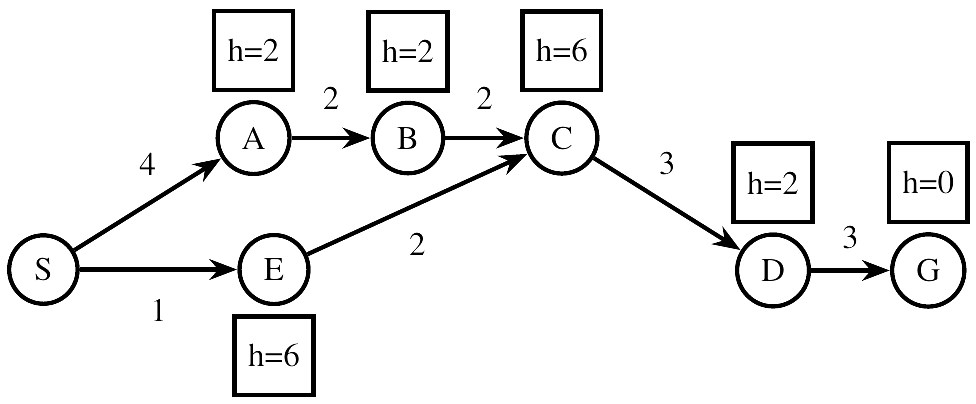
The state graph shows the action cost along the edges and the heuristic function h associated with each state.

Directed state graph with edges S to A (cost 4), S to E (cost 1), A to B (cost 2), B to C (cost 2), E to C (cost 2), C to D (cost 3) and D to G (cost 3). The heuristic values are h=2 for A, h=2 for B, h=6 for C, h=2 for D, h=6 for E and h=0 for G, and no value is shown for S.

Suppose \(A^{*}\) algorithm is applied on this state graph using priority queue to store the frontier. In what sequence are the nodes expanded?

Options for GATE DA 2025 | Question 44

Explanation

Answer: (C)

A* always expands the frontier node with the smallest \(f = g + h\), where \(g\) is the path cost from S.

  • Expand S: frontier A (\(4 + 2 = 6\)) and E (\(1 + 6 = 7\)).
  • Expand A (6): add B (\(6 + 2 = 8\)).
  • Expand E (7): add C (\(3 + 6 = 9\)).
  • Expand B (8): reaching C through B costs 8, worse than 3, so C keeps \(f = 9\).
  • Expand C (9): add D (\(6 + 2 = 8\)).
  • Expand D (8): add G (\(9 + 0 = 9\)), and finally expand G.

The order is S, A, E, B, C, D, G. Option A expands C (9) before B (8), and ordering by \(h\) alone would put B before E, as in option D.

Answer: C

GATE DA 2024 | Question 23

MCQ · 1 mark · −0.33

Let \(h_{1}\) and \(h_{2}\) be two admissible heuristics used in \(A^{*}\) search.

Which ONE of the following expressions is always an admissible heuristic?

Options for GATE DA 2024 | Question 23

Explanation

Answer: (D)

A heuristic is admissible when \(0 \leq h(n) \leq h^{*}(n)\) for every node \(n\), where \(h^{*}(n)\) is the true cost of reaching the goal. Because both values are non-negative,

\[|h_{1}(n) - h_{2}(n)| \leq \max(h_{1}(n), h_{2}(n)) \leq h^{*}(n),\]

so option D never overestimates.

The other expressions can overestimate. With \(h^{*}(n) = 5\) and \(h_{1}(n) = h_{2}(n) = 5\), both admissible, the sum is 10 and the product is 25. With \(h_{1}(n) = 5\) and \(h_{2}(n) = 0.1\), the ratio is 50.

Answer: D

GATE DA 2024 | Question 24

MCQ · 1 mark · −0.33

Consider five random variables \(U, V, W, X\), and \(Y\) whose joint distribution satisfies:

\[P(U, V, W, X, Y) = P(U)P(V)P(W \mid U, V)P(X \mid W)P(Y \mid W)\]

Which ONE of the following statements is FALSE?

Options for GATE DA 2024 | Question 24

Explanation

Answer: (C)

The factorisation is the Bayesian network \(U \rightarrow W \leftarrow V\), \(W \rightarrow X\), \(W \rightarrow Y\).

  • A and B: \(U\) and \(V\) reach \(X\) and \(Y\) only through chains such as \(V \rightarrow W \rightarrow Y\), and observing \(W\) blocks a chain. Both are true.
  • D: \(X \leftarrow W \rightarrow Y\) has \(W\) as a common cause, so \(X\) and \(Y\) are independent once \(W\) is known. True.
  • C: \(U\) and \(V\) are independent on their own (the factor \(P(U)P(V)\)), but \(W\) is their common effect. Observing a common effect couples its causes (explaining away): once \(W\) is known, learning \(U\) changes what \(V\) is likely to be. So C does not hold in general.

Answer: C

GATE DA 2024 | Question 25

MCQ · 1 mark · −0.33

Consider the following statement:

In adversarial search, \(\alpha\)–\(\beta\) pruning can be applied to game trees of any depth where \(\alpha\) is the (m) value choice we have formed so far at any choice point along the path for the MAX player and \(\beta\) is the (n) value choice we have formed so far at any choice point along the path for the MIN player.

Which ONE of the following choices of (m) and (n) makes the above statement valid?

Options for GATE DA 2024 | Question 25

Explanation

Answer: (C)

Alpha–beta pruning carries two bounds down the game tree:

  • \(\alpha\) is the value MAX can already guarantee along the path. MAX wants large values, so \(\alpha\) is the highest value found so far.
  • \(\beta\) is the value MIN can already guarantee. MIN wants small values, so \(\beta\) is the lowest value found so far.

A branch is pruned as soon as \(\alpha \geq \beta\), because the player choosing above it already has a better alternative and would never let play reach it. The other options give MAX, MIN or both the preference of the opponent, so the bounds would no longer be values that player can guarantee.

Answer: C

GATE DA 2024 | Question 29

MSQ · 1 mark

Let \(x\) and \(y\) be two propositions. Which of the following statements is a tautology /are tautologies?

Options for GATE DA 2024 | Question 29

Explanation

Answer: (B), (C), (D)

An implication is false only when its premise is true and its conclusion is false. Each premise here is true in exactly one row of the truth table, so check the conclusion in that row.

  • A: \(\neg x \land y\) needs \(x\) false and \(y\) true. Then \(y \Longrightarrow x\) is true \(\Longrightarrow\) false, which is false. Not a tautology.
  • B: \(x \land \neg y\) needs \(x\) true and \(y\) false. Then \(\neg x\) is false, so \(\neg x \Longrightarrow y\) is true. Tautology.
  • C: \(x\) false and \(y\) true make \(\neg x \Longrightarrow y\) true \(\Longrightarrow\) true, which is true. Tautology.
  • D: \(x\) true and \(y\) false make \(y \Longrightarrow x\) false \(\Longrightarrow\) true, which is true. Tautology.

Answer: B, C, D

GATE DA 2024 | Question 44

MCQ · 2 marks · −0.66

Consider a state space where the start state is number 1. The successor function for the state numbered \(n\) returns two states numbered \(n+1\) and \(n+2\). Assume that the states in the unexpanded state list are expanded in the ascending order of numbers and the previously expanded states are not added to the unexpanded state list.

Which ONE of the following statements about breadth-first search (BFS) and depth-first search (DFS) is true, when reaching the goal state number 6?

Options for GATE DA 2024 | Question 44

Explanation

Answer: (C)

Successors come out as \(n+1\) and then \(n+2\), and the smaller number always goes first.

  • BFS: expanding 1 queues 2 and 3; expanding 2 adds 4 (3 is already waiting); expanding 3 adds 5; expanding 4 adds 6; expanding 5 adds 7. Then 6 leaves the queue. Expanded: 1, 2, 3, 4, 5.
  • DFS: it always dives into the smaller child \(n+1\), so it expands 1, 2, 3, 4, 5 and then reaches 6.

Both searches expand the same five states before reaching the goal (or four each if the goal is tested when it is generated, since both then stop while expanding 4). State 6 is reachable, so option D is false.

Answer: C

GATE DA 2024 | Question 54

MSQ · 2 marks

Let game(ball, rugby) be true if the ball is used in rugby and false otherwise.

Let shape(ball, round) be true if the ball is round and false otherwise.

Consider the following logical sentences:

s1: \(\forall \textit{ball}\ \neg\, \textit{game(ball, rugby)} \Longrightarrow \textit{shape(ball, round)}\)

s2: \(\forall \textit{ball}\ \neg\, \textit{shape(ball, round)} \Longrightarrow \textit{game(ball, rugby)}\)

s3: \(\forall \textit{ball}\ \textit{game(ball, rugby)} \Longrightarrow \neg\, \textit{shape(ball, round)}\)

s4: \(\forall \textit{ball}\ \textit{shape(ball, round)} \Longrightarrow \neg\, \textit{game(ball, rugby)}\)

Which of the following choices is/are logical representations of the assertion,
“All balls are round except balls used in rugby”?

Options for GATE DA 2024 | Question 54

Explanation

Answer: (A), (C)

The assertion says two things about every ball: a ball not used in rugby is round, and a ball used in rugby is not round.

  • s1 states the first part, and s2 is its contrapositive (a ball that is not round is used in rugby), so s1 and s2 say the same thing.
  • s3 states the second part, and s4 is its contrapositive, so s3 and s4 say the same thing.

A correct representation needs one sentence from each pair, so \(s1 \wedge s3\) (A) and \(s2 \wedge s3\) (C) both work. Option B repeats the first part and would still allow a round rugby ball; option D repeats the second part and would allow a non-rugby ball that is not round.

Answer: A, C