GATE DA 2024 | Question 64
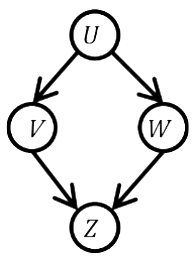
Given the following Bayesian Network consisting of four Bernoulli random variables and the associated conditional probability tables:
| \(P(\cdot)\) | |
|---|---|
| \(U = 0\) | 0.5 |
| \(U = 1\) | 0.5 |
| \(P(V = 0 | \cdot)\) | \(P(V = 1 | \cdot)\) | |
|---|---|---|
| \(U = 0\) | 0.5 | 0.5 |
| \(U = 1\) | 0.5 | 0.5 |
| \(P(W = 0 | \cdot)\) | \(P(W = 1 | \cdot)\) | |
|---|---|---|
| \(U = 0\) | 1 | 0 |
| \(U = 1\) | 0 | 1 |
| \(P(Z = 0 | \cdot)\) | \(P(Z = 1 | \cdot)\) | ||
|---|---|---|---|
| \(V = 0\) | \(W = 0\) | 0.5 | 0.5 |
| \(V = 0\) | \(W = 1\) | 1 | 0 |
| \(V = 1\) | \(W = 0\) | 1 | 0 |
| \(V = 1\) | \(W = 1\) | 0.5 | 0.5 |
The value of \(P(U = 1, V = 1, W = 1, Z = 1) =\) ______ (rounded off to three decimal places).
Explanation
Answer: 0.13
A Bayesian network factorises the joint probability into one factor per node, each conditioned on that node's parents. Here U has no parents, V and W each have parent U, and Z has parents V and W:
\[ P(U, V, W, Z) = P(U)\,P(V|U)\,P(W|U)\,P(Z|V, W) \]
Reading the tables for \(U = 1, V = 1, W = 1, Z = 1\):
- \(P(U = 1) = 0.5\)
- \(P(V = 1|U = 1) = 0.5\)
- \(P(W = 1|U = 1) = 1\)
- \(P(Z = 1|V = 1, W = 1) = 0.5\)
So the joint probability is \(0.5 \times 0.5 \times 1 \times 0.5 = 0.125\).
Answer: 0.125