Consider the following algorithm someAlgo that takes an undirected graph \(G\) as input.
someAlgo(\(G\))
- Let \(v\) be any vertex in \(G\). Run BFS on \(G\) starting at \(v\). Let \(u\) be a vertex in \(G\) at maximum distance from \(v\) as given by the BFS.
- Run BFS on \(G\) again with \(u\) as the starting vertex. Let \(z\) be the vertex at maximum distance from \(u\) as given by the BFS.
- Output the distance between \(u\) and \(z\) in \(G\).
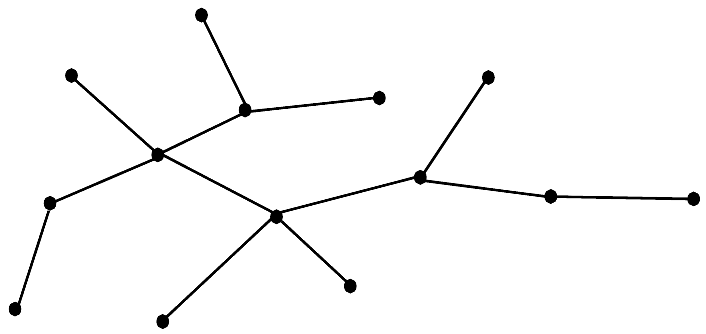
The output of someAlgo(\(T\)) for the tree shown in the given figure is ___________. (Answer in integer)
Answer
6
Explanation
On a tree, a vertex farthest from any start vertex is always an end of a longest path, so the second BFS measures the tree's diameter: the largest distance, in edges, between two vertices.
In the figure, a longest path starts at the lowest leaf on the far left, goes up to its neighbour and the left branching vertex, crosses to the central branching vertex, and follows the right branch through two more vertices to the rightmost leaf: 6 edges. The topmost leaf also reaches the rightmost leaf in 6 edges, and no two vertices are farther apart.
So the output is 6 whichever start vertex \(v\) is chosen.
Answer: 6