Graph Traversals

GATE CS previous year questions · 4 questions

GATE CS 2025 Set 2 | Question 29

MSQ · 1 mark

Which of the following statements regarding Breadth First Search (BFS) and Depth First Search (DFS) on an undirected simple graph \(G\) is/are TRUE?

Options for GATE CS 2025 Set 2 | Question 29

Explanation

Answer: (B), (C), (D)

  • (A) False. In a triangle on \(s, a, b\), DFS from \(s\) may go \(s \to a \to b\), placing \(b\) at depth 2 although the edge \(sb\) puts it at distance 1.
  • (B) True. If \(u\) is discovered before its neighbour \(v\), then \(v\) is discovered before \(u\) finishes, so \(v\) becomes a descendant of \(u\). Every non-tree edge therefore joins a vertex to one of its ancestors; undirected DFS has no cross edges.
  • (C) True. BFS depths are shortest distances from \(s\), and an edge \((u, v)\) gives \(d(v) \le d(u) + 1\) and \(d(u) \le d(v) + 1\).
  • (D) True. Restarting the search (BFS or DFS) from each unvisited vertex visits exactly one connected component per start.

Answer: B, C, D
GATE CS 2025 Set 2 | Question 59

NAT · 2 marks

Consider the following algorithm someAlgo that takes an undirected graph \(G\) as input.

someAlgo(\(G\))

  1. Let \(v\) be any vertex in \(G\). Run BFS on \(G\) starting at \(v\). Let \(u\) be a vertex in \(G\) at maximum distance from \(v\) as given by the BFS.
  2. Run BFS on \(G\) again with \(u\) as the starting vertex. Let \(z\) be the vertex at maximum distance from \(u\) as given by the BFS.
  3. Output the distance between \(u\) and \(z\) in \(G\).

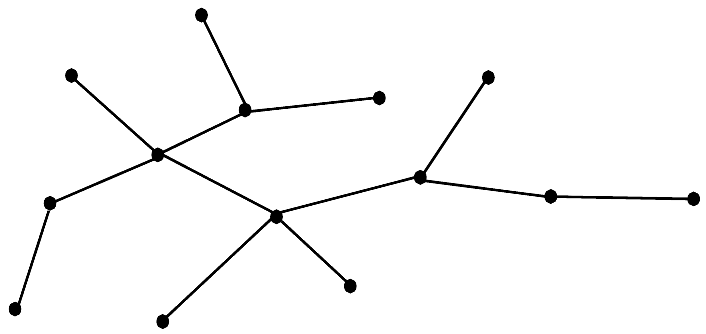
The output of someAlgo(\(T\)) for the tree shown in the given figure is ___________. (Answer in integer)

A tree with 14 vertices drawn as dots joined by edges. One vertex is joined to a leaf, to a vertex with two further leaves, to a vertex with one further leaf, and to a second branching vertex; that second vertex has two leaves and one more neighbour, which has a leaf and a two-edge path hanging from it.

Explanation

Answer: 6

On a tree, a vertex farthest from any start vertex is always an end of a longest path, so the second BFS measures the tree's diameter: the largest distance, in edges, between two vertices.

In the figure, a longest path starts at the lowest leaf on the far left, goes up to its neighbour and the left branching vertex, crosses to the central branching vertex, and follows the right branch through two more vertices to the rightmost leaf: 6 edges. The topmost leaf also reaches the rightmost leaf in 6 edges, and no two vertices are farther apart.

So the output is 6 whichever start vertex \(v\) is chosen.

Answer: 6

GATE CS 2024 Set 1 | Question 45

MSQ · 2 marks

Let \(G\) be a directed graph and \(T\) a depth first search (DFS) spanning tree in \(G\) that is rooted at a vertex \(v\). Suppose \(T\) is also a breadth first search (BFS) tree in \(G\), rooted at \(v\). Which of the following statements is/are TRUE for every such graph \(G\) and tree \(T\) ?

Options for GATE CS 2024 Set 1 | Question 45

Explanation

Answer: (C)

In a BFS tree the depth of every vertex equals its shortest distance from \(v\), and any edge \((u, w)\) forces \(\text{dist}(w) \le \text{dist}(u) + 1\).

  • C is true. A forward edge \((u, w)\) leads to a descendant \(w\) of \(u\) that is not its child, so \(w\) is at least two levels below \(u\) in \(T\). The edge itself gives \(\text{dist}(w) \le \text{dist}(u) + 1\), a contradiction.
  • A and D are false: with the edges \(v \to u\) and \(u \to v\), both searches give the tree \(v \to u\), and \(u \to v\) is a back edge.
  • B is false: with the edges \(v \to a\), \(v \to b\) and \(b \to a\), a DFS that visits \(a\) first builds the tree \(v \to a\), \(v \to b\), which is also the BFS tree, and \(b \to a\) is a cross edge.

Answer: C

GATE CS 2024 Set 1 | Question 60

NAT · 2 marks

The number of edges present in the forest generated by the DFS traversal of an undirected graph \(G\) with 100 vertices is 40. The number of connected components in \(G\) is _________

Explanation

Answer: 60

A DFS of an undirected graph grows one tree for each connected component: a new tree starts only when no unvisited vertex is reachable from the earlier ones. So the number of trees in the DFS forest equals the number of components.

A tree on \(t\) vertices has \(t - 1\) edges, so a forest with \(n\) vertices and \(c\) trees has \(n - c\) edges:

\[100 - c = 40 \quad\Rightarrow\quad c = 60\]

Edges of \(G\) that are not in the forest (back edges) do not change this, so \(G\) has 60 connected components.

Answer: 60