Algorithms

GATE CS previous year questions · 16 questions

Topics

GATE CS 2025 Set 1 | Question 18

MCQ · 1 mark · −0.33

Let \(G\) be any undirected graph with positive edge weights, and \(T\) be a minimum spanning tree of \(G\). For any two vertices, \(u\) and \(v\), let \(d_{1}(u, v)\) and \(d_{2}(u, v)\) be the shortest distances between \(u\) and \(v\) in \(G\) and \(T\), respectively. Which ONE of the options is CORRECT for all possible \(G, T, u\) and \(v\)?

Options for GATE CS 2025 Set 1 | Question 18

Explanation

Answer: (B)

\(T\) is a subgraph of \(G\), so every path between \(u\) and \(v\) in \(T\) is also a path in \(G\). Hence the shortest path in \(G\) can never be longer than the one in \(T\): \(d_1(u, v) \le d_2(u, v)\).

Equality is not guaranteed. Take a triangle \(x, y, z\) with \(w(x, y) = w(y, z) = 1\) and \(w(x, z) = 1.5\); the MST keeps the two edges of weight 1. Then \(d_1(x, z) = 1.5\) but \(d_2(x, z) = 2\), which rules out (A) and (C), while \(d_1(x, y) = d_2(x, y) = 1\) rules out (D).

Answer: B
GATE CS 2025 Set 1 | Question 20

MCQ · 1 mark · −0.33

Consider the following recurrence relation:

\(T(n) = 2T(n - 1) + n2^{n}\) for \(n \gt 0\), \(T(0) = 1\).

Which ONE of the following options is CORRECT?

Options for GATE CS 2025 Set 1 | Question 20

Explanation

Answer: (A)

Divide both sides by \(2^{n}\) and put \(S(n) = T(n)/2^{n}\). The recurrence becomes \(S(n) = S(n - 1) + n\) with \(S(0) = 1\).

So \(S(n) = 1 + (1 + 2 + \dots + n) = 1 + \frac{n(n+1)}{2}\), and \(T(n) = 2^{n}\left(1 + \frac{n(n+1)}{2}\right) = \Theta(n^{2}2^{n})\).

Answer: A

GATE CS 2025 Set 1 | Question 33

NAT · 1 mark

The pseudocode of a function fun() is given below:

fun(int A[0,…,n-1]){
    for i=0 to n-2
        for j=0 to n-i-2
            if (A[j]>A[j+1])
                then swap A[j] and A[j+1]

}

Let \(A[0, \ldots, 29]\) be an array storing 30 distinct integers in descending order. The number of swap operations that will be performed, if the function fun() is called with \(A[0, \ldots, 29]\) as argument, is __________. (Answer in integer)

Explanation

Answer: 435

fun() is bubble sort. Each swap exchanges one adjacent out-of-order pair, so it removes exactly one inversion, and the total number of swaps equals the number of inversions in the input.

In a descending array of 30 distinct values every pair is an inversion, so the count is \(\binom{30}{2} = \frac{30 \times 29}{2} = 435\). Pass by pass gives the same total: pass \(i\) makes \(29 - i\) comparisons and every one of them swaps, so \(29 + 28 + \cdots + 1 = 435\).

Answer: 435

GATE CS 2025 Set 1 | Question 64

NAT · 2 marks

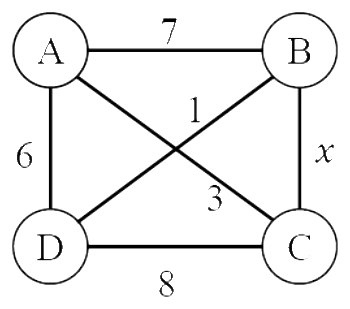
The maximum value of \(x\) such that the edge between the nodes B and C is included in every minimum spanning tree of the given graph is _________ . (answer in integer)

Weighted graph on A, B, C, D: AB = 7, AD = 6, CD = 8, BC = x, and crossing diagonals BD and AC with weights 1 and 3

Explanation

Answer: 5

The diagonals BD and AC (weights 1 and 3) are in every MST: BD is the unique lightest edge at D (DA = 6, DC = 8) and AC is the unique lightest edge at A (AD = 6, AB = 7). Together they form two pieces, {A, C} and {B, D}.

A spanning tree on 4 vertices has 3 edges, so exactly one more edge must join the two pieces. The candidates are BC = \(x\), AD = 6, AB = 7 and CD = 8. BC is in every MST only if it is strictly the lightest of these, i.e. \(x \lt 6\).

At \(x = 6\), BC ties with AD and {BD, AC, AD} is an MST without BC. So the largest integer value is 5.

Answer: 5

GATE CS 2025 Set 2 | Question 20

MCQ · 1 mark · −0.33

Consider an unordered list of \(N\) distinct integers.

What is the minimum number of element comparisons required to find an integer in the list that is NOT the largest in the list?

Options for GATE CS 2025 Set 2 | Question 20

Explanation

Answer: (A)

Pick any two elements and compare them once. Because the integers are distinct, one of them is strictly smaller, and that smaller element cannot be the largest in the list: the other element beats it. So one comparison always suffices.

Zero comparisons cannot work, since without any comparison every element we might pick could still be the maximum. Hence the minimum is 1.

\(N - 1\) comparisons are what it takes to find the largest element itself, which is a different task; the question only asks for some element that is not the largest.

Answer: A

GATE CS 2025 Set 2 | Question 29

MSQ · 1 mark

Which of the following statements regarding Breadth First Search (BFS) and Depth First Search (DFS) on an undirected simple graph \(G\) is/are TRUE?

Options for GATE CS 2025 Set 2 | Question 29

Explanation

Answer: (B), (C), (D)

  • (A) False. In a triangle on \(s, a, b\), DFS from \(s\) may go \(s \to a \to b\), placing \(b\) at depth 2 although the edge \(sb\) puts it at distance 1.
  • (B) True. If \(u\) is discovered before its neighbour \(v\), then \(v\) is discovered before \(u\) finishes, so \(v\) becomes a descendant of \(u\). Every non-tree edge therefore joins a vertex to one of its ancestors; undirected DFS has no cross edges.
  • (C) True. BFS depths are shortest distances from \(s\), and an edge \((u, v)\) gives \(d(v) \le d(u) + 1\) and \(d(u) \le d(v) + 1\).
  • (D) True. Restarting the search (BFS or DFS) from each unvisited vertex visits exactly one connected component per start.

Answer: B, C, D

GATE CS 2025 Set 2 | Question 37

MCQ · 2 marks · −0.66

Let \(G\) be an edge-weighted undirected graph with positive edge weights. Suppose a positive constant \(\alpha\) is added to the weight of every edge.

Which ONE of the following statements is TRUE about the minimum spanning trees (MSTs) and shortest paths (SPs) in \(G\) before and after the edge weight update?

Options for GATE CS 2025 Set 2 | Question 37

Explanation

Answer: (C)

MSTs stay. Every spanning tree of a connected graph with \(n\) vertices has exactly \(n - 1\) edges, so every spanning tree gets heavier by the same amount, \((n - 1)\alpha\). Their order by weight does not change, so every MST remains an MST.

SPs can change. A path with \(k\) edges gets heavier by \(k\alpha\), so paths with more edges are penalised more. Take edges \(uv\) and \(vw\) of weight 1 and an edge \(uw\) of weight 3. The shortest path from \(u\) to \(w\) is \(u, v, w\) with weight 2. After adding \(\alpha = 2\) it weighs 6, while the single edge \(uw\) weighs 5, so the old SP is no longer shortest.

Answer: C

GATE CS 2025 Set 2 | Question 38

MCQ · 2 marks · −0.66

A meld operation on two instances of a data structure combines them into one single instance of the same data structure. Consider the following data structures:

P: Unsorted doubly linked list with pointers to the head node and tail node of the list.

Q: Min-heap implemented using an array.

R: Binary Search Tree.

Which ONE of the following options gives the worst-case time complexities for meld operation on instances of size \(n\) of these data structures?

Options for GATE CS 2025 Set 2 | Question 38

Explanation

Answer: (A)

  • P: link the tail of one list to the head of the other and update the tail pointer. That is a fixed number of pointer changes: \(\Theta(1)\).
  • Q: copy both arrays into one array of size \(2n\) and run bottom-up build-heap, which takes linear time: \(\Theta(n)\). Inserting the \(n\) keys one at a time would cost \(\Theta(n \log n)\), so that bound (B, C) is not the best.
  • R: an in-order traversal of each tree gives two sorted lists in \(\Theta(n)\). Merge them in \(\Theta(n)\), then build a BST from the merged list (middle element as root, recursively) in \(\Theta(n)\). Inserting one tree’s keys into the other would give the slower \(\Theta(n \log n)\) or \(\Theta(n^{2})\) of D and C.

Answer: A

GATE CS 2025 Set 2 | Question 41

MCQ · 2 marks · −0.66

An array \(A\) of length \(n\) with distinct elements is said to be bitonic if there is an index \(1 \le i \le n\) such that \(A[1..i]\) is sorted in the non-decreasing order and \(A[i+1..n]\) is sorted in the non-increasing order.

Which ONE of the following represents the best possible asymptotic bound for the worst-case number of comparisons by an algorithm that searches for an element in a bitonic array \(A\)?

Options for GATE CS 2025 Set 2 | Question 41

Explanation

Answer: (D)

Search in three binary-search phases:

  1. Find the peak: compare \(A[m]\) with \(A[m+1]\). If \(A[m] < A[m+1]\) the peak is to the right, otherwise at \(m\) or to its left. Each comparison halves the range: \(O(\log n)\).
  2. Binary search the increasing part \(A[1..i]\).
  3. Binary search the decreasing part \(A[i+1..n]\).

That is \(O(\log n)\) comparisons in all, and no algorithm can do better: a sorted array is itself bitonic (take \(i = n\)), and searching a sorted array needs \(\Omega(\log n)\) comparisons. So the bound is \(\Theta(\log n)\); \(\Theta(\log^{2} n)\) is achievable but not the best, and \(\Theta(1)\) is impossible.

Answer: D

GATE CS 2025 Set 2 | Question 59

NAT · 2 marks

Consider the following algorithm someAlgo that takes an undirected graph \(G\) as input.

someAlgo(\(G\))

  1. Let \(v\) be any vertex in \(G\). Run BFS on \(G\) starting at \(v\). Let \(u\) be a vertex in \(G\) at maximum distance from \(v\) as given by the BFS.
  2. Run BFS on \(G\) again with \(u\) as the starting vertex. Let \(z\) be the vertex at maximum distance from \(u\) as given by the BFS.
  3. Output the distance between \(u\) and \(z\) in \(G\).

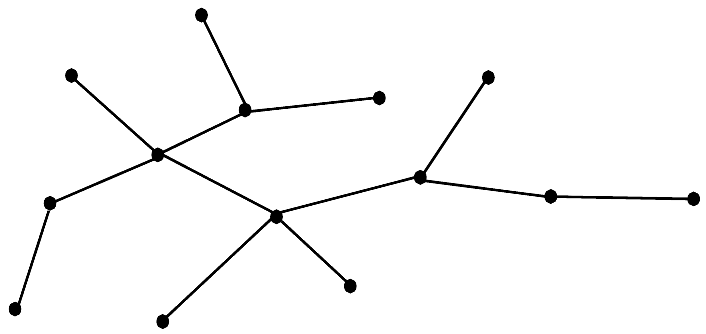
The output of someAlgo(\(T\)) for the tree shown in the given figure is ___________. (Answer in integer)

A tree with 14 vertices drawn as dots joined by edges. One vertex is joined to a leaf, to a vertex with two further leaves, to a vertex with one further leaf, and to a second branching vertex; that second vertex has two leaves and one more neighbour, which has a leaf and a two-edge path hanging from it.

Explanation

Answer: 6

On a tree, a vertex farthest from any start vertex is always an end of a longest path, so the second BFS measures the tree's diameter: the largest distance, in edges, between two vertices.

In the figure, a longest path starts at the lowest leaf on the far left, goes up to its neighbour and the left branching vertex, crosses to the central branching vertex, and follows the right branch through two more vertices to the rightmost leaf: 6 edges. The topmost leaf also reaches the rightmost leaf in 6 edges, and no two vertices are farther apart.

So the output is 6 whichever start vertex \(v\) is chosen.

Answer: 6